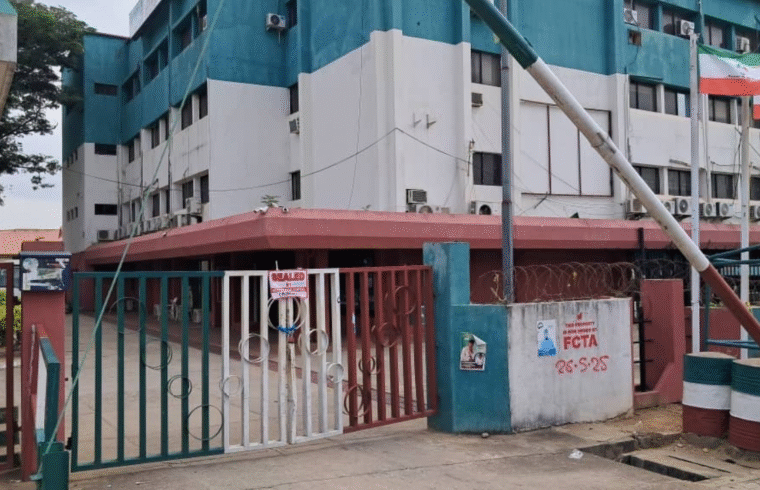
A fresh chapter has opened in the Peoples Democratic Party’s leadership crisis after security operatives shut down the party’s main national offices in Abuja, worsening tensions inside the opposition camp and raising fresh concerns over its internal stability ahead of future elections.
The dramatic development unfolded on Monday when armed officers sealed the PDP National Secretariat at Wadata Plaza shortly after Abdulrahman Mohammed assumed office as Acting National Chairman. Witnesses said security personnel arrived early, ordered staff members and journalists out of the premises, and then secured the gates while taking positions around the complex.
The operation did not stop there. Another team of officers also moved to Legacy House in Maitama, a location tied to the party’s National Convention Organizing Committee. By restricting access to both sites, party operations were effectively brought to a halt, leaving members and workers uncertain about what would follow next.
Those attempting to gain access to the facilities were reportedly turned back, with security officers pointing to instructions from higher authorities. The move quickly created anxiety among party supporters and staff, especially because it came at a time when divisions within the National Working Committee had already become more visible.
At the center of the turmoil is the disputed emergence of Abdulrahman Mohammed as Acting National Chairman. His entry into the position has intensified the battle for control within the PDP, with rival camps offering sharply different interpretations of what his appointment means for the future of the party.
Supporters of Mohammed believe the leadership change is necessary to rescue the PDP from deeper decline. They argue that the previous handlers of the party failed in managing internal affairs and insist that a reset is needed if the opposition hopes to remain competitive heading toward the 2027 political contest.
On the other side, loyalists aligned with the former leadership have rejected Mohammed’s emergence and continue to recognize Umar Damagum as the legitimate Acting National Chairman. For them, the new development is not a lawful correction but an organized attempt to seize control of the party structure through internal force.
As the crisis escalated, staff members at the national secretariat reportedly staged a protest walkout, signaling their frustration with the confusion surrounding the party’s command structure. Their action reflected the growing unease within the organization, where uncertainty now appears to be affecting both leadership and daily operations.
According to Gossip News Now, the sealing of the offices was seen by some insiders as a precaution aimed at preventing clashes between opposing factions. Even so, the heavy security presence only added to the sense of instability and reinforced public perception that the PDP’s internal struggle has entered a more serious phase.
By the time of reporting, both Wadata Plaza and Legacy House remained under tight security watch, while different factions within the party were said to be holding separate emergency consultations in Abuja. Those parallel meetings suggest that, rather than moving closer to resolution, the crisis may still be deepening behind the scenes.
The latest events have now turned what was already a major leadership disagreement into a full-blown institutional standoff. With offices shut, party staff unsettled, and rival camps digging in, the PDP faces a difficult test of credibility at a time when it is expected to present itself as a viable national alternative.
Commentary and Analysis
The shutdown of the party’s headquarters is politically significant because it sends a strong public signal that the PDP’s internal conflict is no longer just a matter of competing statements. It has now reached the point where physical access to party institutions is being restricted, which gives the crisis a more dramatic and troubling dimension.
This kind of development can damage confidence among party members, supporters, and undecided observers. When an opposition party appears unable to maintain order at its own national secretariat, questions naturally arise about how prepared it is to manage larger national responsibilities.
The leadership tussle also reveals how fragile unity within the PDP has become. Rival claims over legitimacy, separate strategy meetings, and staff protests all point to a party struggling not only with power sharing, but with basic internal trust.
Unless the PDP quickly finds a credible path toward reconciliation and clarity, the standoff could continue to hurt its image and weaken its ability to mobilize effectively for future elections. For now, the sealing of its major offices stands as one of the clearest signs yet that the crisis has moved into a more dangerous stage.
© 2025 Gossip News Now, a division of CHIEJOS HARBIAN DIGITAL MEDIA LTD. Contact us via admin@gossipnewsnow.online