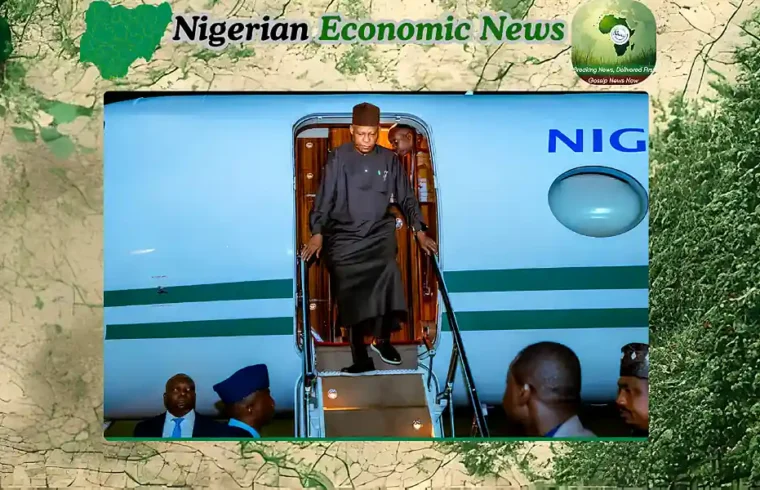
Vice President Kashim Shettima has returned to Nigeria after representing President Bola Ahmed Tinubu at the 18th BRICS Leaders’ Summit in New Delhi, India, where Nigeria used the high-level gathering to pursue deeper economic and diplomatic engagement.
Shettima’s return was confirmed in a statement issued on Tuesday by Stanley Nkwocha, Senior Special Assistant to the President on Media & Communications in the Office of the Vice President.
Beyond his participation in the summit’s high-level sessions, the Vice President held bilateral discussions focused on areas considered important to Nigeria’s economic and strategic interests.
Nigeria’s Trade and Investment Agenda at BRICS
A major component of Shettima’s engagements was his meeting with Indian Prime Minister Narendra Modi, during which both sides discussed opportunities spanning trade, investment and several strategic sectors.
The discussions included renewed crude oil trade, pharmaceuticals, defence, digital technology, fintech and renewable energy.
The breadth of the issues discussed places trade and investment at the centre of Nigeria’s engagement with India, while also highlighting areas where both countries are seeking closer cooperation.
For Nigeria, such engagement cuts across traditional commodities and extends into technology, healthcare, energy and other sectors with potential economic relevance.
Strengthening Nigeria’s International Economic Position
Shettima’s meeting with Ngozi Okonjo-Iweala, Director-General of the World Trade Organisation, also formed part of Nigeria’s international economic engagement during the visit.
According to the statement, the meeting reaffirmed Nigeria’s support for multilateralism and a more inclusive global economic order.
The WTO engagement adds an international institutional dimension to Nigeria’s participation at the summit, coming alongside the country’s bilateral discussions with India and its broader interaction with BRICS member and partner countries.
Nigeria’s Wider BRICS Economic Engagement
At the summit, Shettima delivered President Tinubu’s message calling for reforms of global governance and financial institutions.
He also positioned Nigeria as a gateway to Africa’s expanding market under the African Continental Free Trade Area (AfCFTA).
The summit therefore provided an opportunity for Nigeria to present its economic interests within a wider global and African trade framework.
Nigeria also sought to deepen engagement with BRICS member and partner countries in areas including agriculture, artificial intelligence, digital infrastructure, manufacturing, healthcare, energy and human-capital development.
These areas broaden the scope of the country’s BRICS engagement beyond immediate trade discussions and into sectors connected to technology, production, infrastructure and human development.
What Comes Next for Nigeria’s Economic Engagement?
The significance of the visit will depend on how Nigeria’s international engagements translate into deeper cooperation across the sectors identified during the summit.
The discussions with India, the engagement with the WTO and Nigeria’s broader outreach to BRICS member and partner countries provide several areas for continued economic and diplomatic engagement.
For Nigeria, the focus now shifts from high-level discussions to the broader opportunities associated with trade, investment, technology, energy, manufacturing and other strategic sectors highlighted during the summit.
Nigeria’s Global Economic Outlook
Shettima’s return marks the conclusion of Nigeria’s latest high-level engagement at the BRICS summit, but the economic issues raised during the visit extend beyond the summit itself.
The coming period will show how Nigeria’s efforts to strengthen international partnerships contribute to its trade, investment and broader economic interests, particularly across the sectors identified during the discussions in India.
The BRICS engagement has consequently given Nigeria another platform to advance its international economic relationships while presenting the country as a participant in wider global and African economic opportunities.