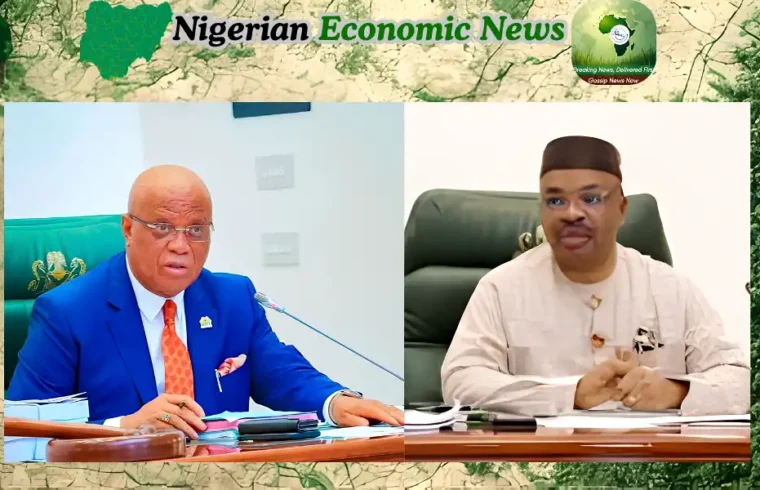
The Akwa Ibom State Government has rejected an allegation linking Governor Umo Eno to the Economic and Financial Crimes Commission’s (EFCC) actions involving former Governor Udom Emmanuel’s Lagos property. The claim was made by African Democratic Congress (ADC) governorship candidate Senator John James Akpanudoedehe, while the state government said Eno had never reported his predecessor to the anti-graft agency. (Premium Times Nigeria)
Key Takeaways
- Senator John James Akpanudoedehe alleged that Governor Umo Eno was involved in reporting former Governor Udom Emmanuel to the EFCC.
- The allegation also linked Eno to EFCC action involving Emmanuel’s Lagos residence.
- The Akwa Ibom Government rejected the claim and said Eno had never reported Emmanuel or anyone else to the EFCC.
- Commissioner for Information Aniekan Umanah said the allegation was unsupported and defended Eno’s relationship with former administrations.
- The government also raised a separate historical issue concerning events surrounding the 2011 governorship election.
The Allegation At The Centre Of The Dispute
The dispute centres on claims made publicly by John James Akpanudoedehe, the ADC governorship candidate in Akwa Ibom.
According to reports of his remarks, Akpanudoedehe alleged that Governor Umo Eno had a role in reporting former Governor Udom Emmanuel to the EFCC and providing information connected to the agency’s action involving Emmanuel’s Lagos residence. (Premium Times Nigeria)
The allegation has not been established as fact in the material reviewed for this report. It remains a claim attributed to Akpanudoedehe.
What The Akwa Ibom Government Has Denied
The Akwa Ibom State Government has rejected the allegation.
Commissioner for Information Aniekan Umanah said Governor Eno had never reported Emmanuel to the EFCC.
The government described the allegation as false and unsupported, while also objecting to what it regarded as an attempt to create tension around the issue. (The Guardian Nigeria)
Governor Eno was quoted as saying:
“I have never reported anyone, talk more of my predecessor in office, to the EFCC.”
The statement represents the government’s position and does not independently establish what caused any EFCC action involving Emmanuel’s property. (QED.ng)
Umanah Explains The Governor’s Position
In defending the governor, Umanah pointed to Eno’s treatment of officials and projects associated with previous administrations.
The commissioner argued that Eno’s conduct toward former state leaders did not support the allegation that he had acted against Emmanuel through the EFCC.
He cited the retention of some officials who served under previous administrations and the continuation of projects initiated by former governors as examples of what the government described as Eno’s approach to governance.
The government has therefore framed its response around Eno’s stated position that he did not report his predecessor to the EFCC. (QED.ng)
Government Raises A Separate Historical Dispute
The response did not stop at the EFCC allegation.
Umanah also referred to events surrounding the build-up to the 2011 Akwa Ibom governorship election, alleging that violence, destruction and arson during that period resulted in damage to public assets, including vehicles acquired for the state’s mass transit programme.
Those assertions were made by the state government as part of its response to Akpanudoedehe and should therefore be understood as the government’s account of those events, rather than as independently established findings in this report.
The historical reference was used by the government to challenge what it described as an attempt to revisit or rewrite aspects of the state’s political history. (The Guardian Nigeria)
What The Report Establishes — And What Remains An Allegation
The central facts that can be established from the available reports are that Akpanudoedehe made the allegation and the Akwa Ibom Government publicly denied it.
The government’s statement specifically rejects the claim that Governor Eno reported Emmanuel to the EFCC. Multiple reports published in September 2026 carried the same denial from the state government. (Premium Times Nigeria)
However, the allegation itself should not be presented as proof that Eno caused or directed any EFCC action.
Likewise, the government’s denial should be reported as the government’s position unless independently established evidence is available.
This distinction is particularly important because the matter involves allegations concerning public officials and an anti-corruption agency.
Why The EFCC Claim Requires Careful Attribution
The EFCC is a federal anti-corruption agency, while the allegation in this dispute concerns whether a state governor had a role in bringing a former governor or his property to the agency’s attention.
The reports reviewed here do not establish that Governor Eno reported Emmanuel to the EFCC.
What is established for this report is that Akpanudoedehe made the allegation and the Akwa Ibom Government rejected it. (Premium Times Nigeria)
That distinction allows the political dispute to be reported without treating either side’s contested assertion as independently proven.
Frequently Asked Questions
Did Umo Eno report Udom Emmanuel to the EFCC?
The Akwa Ibom Government denies that Governor Umo Eno reported his predecessor, Udom Emmanuel, to the EFCC. The allegation was made publicly by Senator John James Akpanudoedehe. (Premium Times Nigeria)
Who made the allegation against Governor Umo Eno?
The allegation was made by Senator John James Akpanudoedehe, the ADC governorship candidate in Akwa Ibom. (Premium Times Nigeria)
What did the allegation concern?
It concerned claims that Governor Eno was involved in reporting Udom Emmanuel to the EFCC and was connected to the agency’s action involving Emmanuel’s Lagos residence. (The Guardian Nigeria)
Who responded on behalf of the Akwa Ibom Government?
The response was issued by Aniekan Umanah, the Akwa Ibom State Commissioner for Information. (The Guardian Nigeria)
What is Governor Umo Eno’s position?
The position communicated by the government is that Eno has never reported anyone, including his predecessor Udom Emmanuel, to the EFCC. (QED.ng)
Did the government make other claims in its response?
Yes. The government also referred to political events surrounding the 2011 governorship election and defended Eno’s relationship with former administrations. Those claims were part of the government’s response to Akpanudoedehe. (The Guardian Nigeria)
Conclusion
The dispute over Udom Emmanuel, Umo Eno and the EFCC currently centres on competing claims.
Senator John James Akpanudoedehe alleged that Governor Eno was involved in reporting his predecessor to the anti-graft agency, while the Akwa Ibom Government has categorically denied the allegation.
For now, the key distinction is between the allegation made by Akpanudoedehe and the government’s denial of that allegation. The available reports do not establish the allegation as fact.
Comment Prompt
What is your view on the dispute between John Akpanudoedehe and the Akwa Ibom Government over the EFCC allegation involving Udom Emmanuel? Share your thoughts in the comments.
© 2025 Gossip News Now, a division of CHIEJOS HARBIAN DIGITAL MEDIA LTD.
Contact us via admin@gossipnewsnow.online