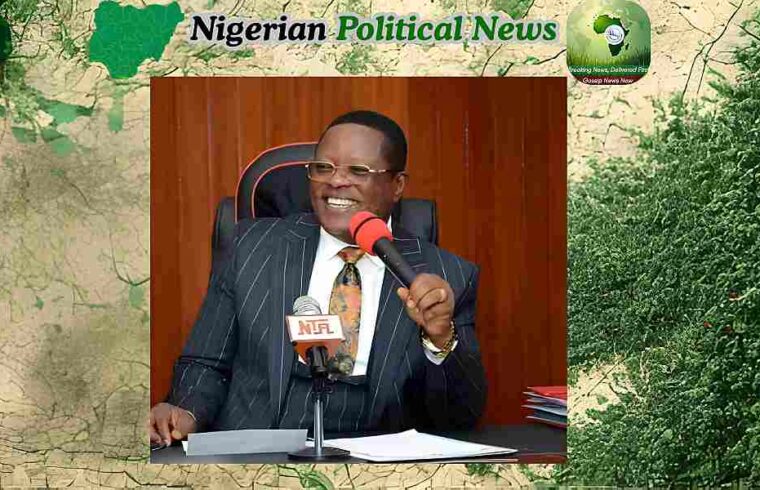
Minister of Works David Umahi has expressed confidence that President Bola Tinubu can secure victory in all five South-East states in the 2027 presidential election, while urging residents of the region to move beyond regional politics.
Umahi made the remarks during an interview on Channels Television’s Sunday Politics, where he argued that the South-East should maintain a broader national outlook and recognise what he described as the Tinubu administration’s efforts to integrate the region into the federal government.
Key Takeaways
- David Umahi believes Bola Tinubu can win all five South-East states in the 2027 election.
- Umahi urged South-East residents to avoid what he described as regional politics.
- He said Tinubu’s administration has integrated the South-East into the federal government.
- The five states are currently controlled by different political parties, according to the supplied report.
- Umahi contrasted the current administration’s approach with that of former President Muhammadu Buhari.
- He also pointed to ongoing discussions about creating a sixth state in the South-East.
Umahi’s 2027 South-East Election Argument
Umahi’s comments place the South-East at the centre of his expectations for the 2027 presidential contest.
According to the minister, Tinubu could make significant electoral gains across the region, including winning all five South-East states.
“The president is going to harvest a lot of votes in the south-east.”
Umahi added:
“My faith is telling me we will win the five states. I’m working for it. I’m explaining to our people.”
The minister also urged residents of the region not to approach national politics solely through a regional lens.
“We shouldn’t play regional politics. It doesn’t help us.”
He said the South-East should instead seek what he described as a broader national relationship and a “handshake across the nation.”
Umahi’s comments represent his political assessment of the region’s prospects ahead of 2027. They should not, however, be interpreted as evidence that the outcome of the election has already been determined.
The Five States and the Current Political Landscape
The political situation across the five South-East states provides important context for Umahi’s projection.
The supplied report states that the All Progressives Congress (APC) currently controls Imo, Enugu and Ebonyi, while the Labour Party (LP) controls Abia and the All Progressives Grand Alliance (APGA) controls Anambra.
That distribution means the political landscape in the region is not controlled by a single party.
Against that background, Umahi’s expectation that Tinubu could win all five states represents a significant electoral target for the APC and the president’s supporters in the region.
The statement therefore goes beyond a general expression of support for Tinubu. It sets out an ambitious political objective covering the entire South-East.
Umahi Says Tinubu Has Taken a Different Approach
A major part of Umahi’s argument concerns the relationship between the South-East and the federal government.
The minister said the administration of former President Muhammadu Buhari did not favour the region, arguing that the South-East was largely excluded from key government appointments.
Umahi contrasted that experience with what he described as the approach of the Tinubu administration.
He argued that Tinubu has placed greater emphasis on integrating the South-East into his government and pointed to senior appointments involving people from the region.
“The president has fully integrated the South-East. Remember, we had the Naval Chief; now we have the Air Force Chief.”
According to Umahi, the broader objective is to treat the country as one united family.
His argument is that the South-East should not be seeking preferential treatment, but rather what he considers fair representation within the Nigerian political system.
“The South-East is not asking for treatment better than others. We just want to be fairly treated.”
What Umahi’s Position Means Politically
Umahi’s remarks combine two related political arguments.
The first is electoral: he believes the Tinubu administration can secure enough support to win across the five South-East states in 2027.
The second concerns the relationship between the federal government and the region. Umahi is presenting government representation, appointments and what he describes as fair treatment as part of the broader political conversation in the South-East.
His comments also suggest that he sees the relationship between the region and the federal government as extending beyond party politics.
By urging South-East residents to avoid regional politics, Umahi is advocating a political approach based on wider national integration rather than a strictly regional outlook.
However, the supplied article does not provide polling figures, voting data or other evidence capable of independently establishing whether Tinubu is likely to win the five states.
The electoral claim therefore remains Umahi’s stated expectation.
The Sixth-State Question Enters the Conversation
Umahi also addressed the long-running issue of state creation in the South-East.
While thanking the National Assembly, he said discussions aimed at creating a sixth state for the region were still progressing.
“We are talking about getting the 6th state in the South-East. It’s a work in progress.”
He connected the issue to his argument about fairness and equity, saying the region should have what other parts of the country have.
“Equity demands that we should have what other people have.”
The comment adds another dimension to Umahi’s argument about the relationship between the South-East and the federal political system.
It also places the sixth-state question alongside his broader call for what he regards as fair treatment and greater national integration.
Strategic Assessment: The Road to 2027
Umahi’s position presents the South-East as an important part of the political calculations surrounding the 2027 presidential election.
His stated objective is particularly ambitious because the five states are currently divided among three political parties, according to the supplied report.
His strategy, as presented in the interview, appears to rest on the argument that the Tinubu administration’s relationship with the South-East can translate into stronger political support.
The minister also appears to believe that government appointments and what he describes as fair treatment can influence how residents of the region view the federal administration.
Whether those factors will translate into electoral support cannot be established from the supplied article alone.
What is clear is that Umahi is actively making the case for Tinubu among South-East residents and wants the region to approach national politics from a broader perspective.
Election Outlook: What to Watch Before 2027
The 2027 election remains ahead, meaning Umahi’s projection will ultimately be tested by the political developments and voting decisions that emerge before election day.
For now, the available information establishes his position but does not establish the eventual electoral outcome.
The political situation in the five South-East states, the competing strength of the parties that currently control them, and the wider relationship between the region and the federal government will remain relevant to the debate surrounding the 2027 contest.
Umahi’s comments therefore provide one political perspective on the direction the South-East could take, rather than a confirmed indication of how voters will ultimately cast their ballots.
Final Editorial Wrap-Up
David Umahi’s prediction that Bola Tinubu can win all five South-East states gives an indication of the electoral ambition being presented ahead of the 2027 presidential election.
His argument is built around broader national integration, political representation and what he describes as fair treatment for the South-East. He has also linked those issues to the region’s relationship with the current federal administration.
At the same time, the political landscape across the five states remains divided among different parties, and the supplied report contains no polling or voting data that can independently confirm Umahi’s prediction.
For now, the minister’s comments should therefore be understood as a political position and campaign objective ahead of 2027. Whether that ambition can translate into electoral victories across the entire South-East will ultimately depend on developments leading up to the election and the decisions of voters.