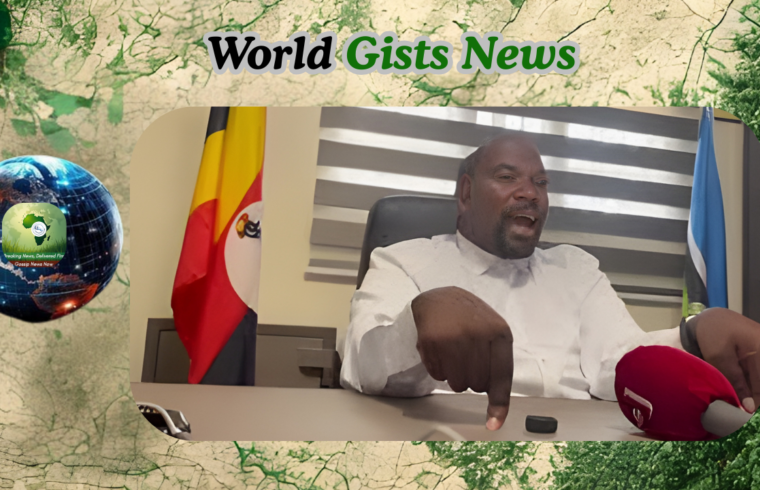
Fresh controversy has erupted in Uganda’s political space after a senior aide to President Yoweri Museveni made comments suggesting that the veteran leader’s hold on power is secure regardless of electoral outcomes. The remarks, delivered by Yiga Wamala, have sparked debate ahead of the country’s upcoming presidential vote.
In a widely circulated video, Wamala appeared to discourage citizens from lingering at polling stations after casting their ballots. According to him, ordinary voters and even party representatives would not play a role in counting votes, implying that technology would handle the process. He questioned the purpose of observing vote tabulation if machines were responsible for the tally.
At another point, he suggested that ballot counting would not be openly visible to the public, further intensifying concerns about transparency. He added that access to collation centres would be highly restricted, indicating that only limited individuals — including the candidate and a small number of others — would be permitted inside.
Dismissal of Opposition Hopes
Wamala’s comments also took aim at opposition aspirations, particularly those surrounding Bobi Wine, a prominent challenger in Uganda’s political arena. He dismissed outright the possibility that the opposition could be declared victorious, insisting that Museveni would remain in office.
He reinforced this position by asserting that voting would not remove the incumbent from power, describing such expectations as unrealistic. The language used in the video has since fueled heated exchanges across social media platforms and political circles.
Succession Hints Add Another Layer
Beyond the immediate election, Wamala alluded to a possible future transition involving Museveni’s son, Muhoozi Kainerugaba, who currently serves as Uganda’s Chief of Defence Forces. His suggestion that leadership continuity could remain within the family has added another dimension to an already tense pre-election climate.
A Leader of Nearly Four Decades
Museveni, now 81, first took power in 1986 after an armed insurgency and is seeking a seventh term. For many Ugandans, he has been the only national leader they have ever known. While his early years were marked by reformist rhetoric and relative stability, critics argue that over time his administration has faced mounting accusations of corruption, restricted civic freedoms, and increasing authoritarian tendencies.
Analysis: What the Remarks Signal
Political observers note that statements questioning electoral transparency can erode public trust in democratic processes. Whether Wamala’s comments reflect official policy or personal opinion, they have intensified scrutiny of Uganda’s electoral framework.
The suggestion that vote counting may be conducted without visible public oversight could deepen skepticism among opposition supporters. At the same time, references to succession planning highlight ongoing debates about political continuity and institutional strength in Uganda.
As election season advances, the spotlight will likely remain fixed on how authorities manage voting procedures, ensure transparency, and address growing public concern. The coming weeks may determine whether the controversy fades or further reshapes the political narrative surrounding Museveni’s long tenure.
© 2025 Gossip News Now, a division of CHIEJOS HARBIAN DIGITAL MEDIA LTD. Contact us via admin@gossipnewsnow.online