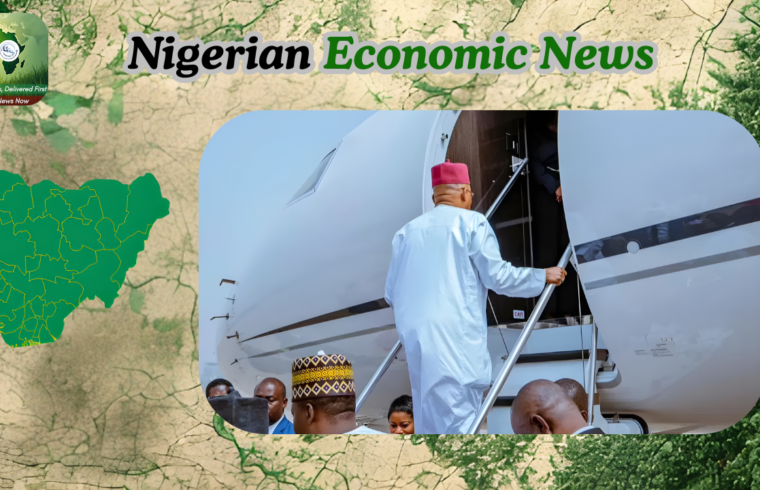
Nigeria’s Vice President Kashim Shettima has commenced an international diplomatic trip combining regional political engagement with global economic discussions, representing President Bola Tinubu at key international events.
Departing Abuja, the Vice President’s first destination was Conakry, Guinea, where he attended the inauguration ceremony of Mamadi Doumbouya, marking a significant milestone in Guinea’s political transition.
Nigeria’s Representation at Guinea’s Leadership Transition
Shettima’s attendance at the swearing-in ceremony symbolized Nigeria’s continued diplomatic involvement in West African stability efforts. The event, held at the GLC Stadium in Nongo, signaled Guinea’s formal return to constitutional governance after years of political uncertainty.
Government officials explained that Nigeria’s participation extends beyond protocol, reflecting broader regional cooperation goals under President Tinubu’s foreign policy direction.
According to presidential communications, the visit reinforces Nigeria’s commitment to democratic consolidation within the ECOWAS sub-region and strengthens bilateral relations between both countries.
Background to Guinea’s Political Journey
Guinea’s current leadership traces back to September 2021, when Mamadi Doumbouya, then a military officer, led a coup that removed former President Alpha Condé following controversy surrounding constitutional amendments for a third term.
The takeover prompted sanctions and suspension from regional and continental bodies. After sustained diplomatic engagement and political negotiations, national elections were conducted, culminating in Doumbouya’s inauguration as elected president.
Nigeria played a role throughout the transition period, supporting dialogue efforts aimed at restoring democratic order.
Economic and Regional Cooperation Outlook
Officials noted that Nigeria’s engagement with Guinea is also tied to expanding economic cooperation. Trade relations between the two nations have gradually improved, particularly in manufactured goods and agricultural exports.
The visit, therefore, served dual purposes — political solidarity and exploration of economic partnerships capable of strengthening West African integration.
At one stage, presidential aides emphasized that Nigeria’s diplomatic presence represents strategic leadership rather than ceremonial participation, highlighting growing commercial ties between both countries.
Next Stop: World Economic Forum in Davos
Following the Guinea engagement, Shettima proceeded to Davos, Switzerland, to participate in the 2026 World Economic Forum Annual Meeting, scheduled from January 19 to 23.
The gathering, themed “A Spirit of Dialogue,” brings together political leaders, business executives, academics, and innovators to discuss global challenges and emerging opportunities.
Key conversations expected at the forum include:
- advancements in artificial intelligence and quantum technologies
- future energy systems and sustainability initiatives
- biotechnology innovation
- workforce transformation in emerging economies
Nigeria’s Strategic Objectives at the Global Forum
During the Davos meetings, the Vice President is expected to engage investors and international partners on Nigeria’s economic reform agenda, investment climate, and Africa’s broader contribution to global economic stability.
Discussions will likely focus on attracting capital, strengthening technological collaboration, and positioning Nigeria as a competitive destination for innovation-driven growth.
Officials indicated that these engagements align with the administration’s Renewed Hope Agenda, aimed at expanding economic opportunities while strengthening international partnerships.
Commentary & Analysis: Balancing Regional Leadership and Global Influence
Shettima’s itinerary illustrates Nigeria’s attempt to maintain influence simultaneously at regional and global levels. Participation in Guinea’s inauguration reinforces Nigeria’s leadership role within West Africa, particularly in promoting democratic governance after political disruptions.
Meanwhile, attendance at the World Economic Forum highlights a strategic pivot toward economic diplomacy, where international partnerships and technological investments are increasingly central to national development plans.
Analysts note that such dual engagements signal a shift in Nigeria’s foreign policy approach — combining political stabilization efforts in Africa with active participation in global economic conversations shaping the future of technology and trade.
By linking regional diplomacy with global economic dialogue, Nigeria positions itself as both a stabilizing force in West Africa and an emerging voice in international development discussions.
The Vice President is expected to return to Nigeria following the conclusion of the Davos engagements.
© 2025 Gossip News Now , a division of CHIEJOS HARBIAN DIGITAL MEDIA LTD. Contact us via admin@gossipnewsnow.online