
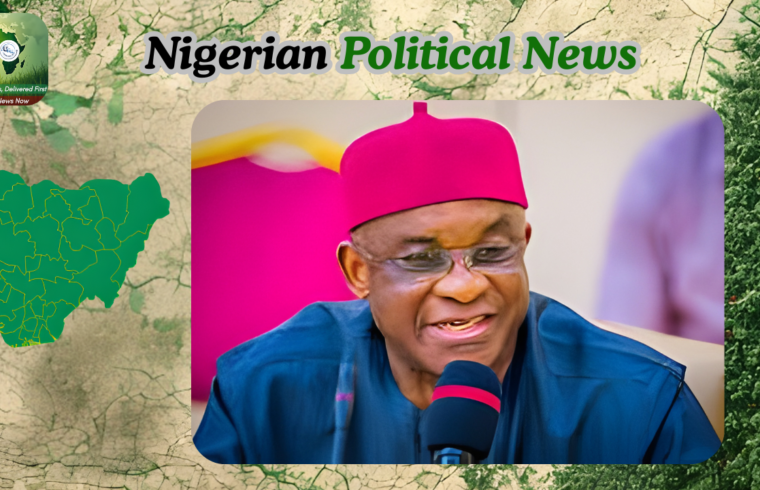
The National Chairman of the African Democratic Congress (ADC), Senator David Mark, has blamed Nigeria’s current economic and social challenges on the All Progressives Congress (APC)-led government, insisting that conditions have deteriorated significantly under its leadership.
According to him, Nigerians already know who is responsible for their hardship and are no longer interested in blame games, but rather in identifying leaders capable of rescuing the country from its present difficulties.
Senator Mark stated that Nigerians are currently enduring more hardship than citizens of most countries around the world, stressing that the situation has worsened during the APC’s time in power.
Gossip News Now reports that the former Senate President made these remarks on Monday while inaugurating the ADC’s Policy and Manifesto Committee.
In his address, Mark challenged members of the committee to move beyond surface-level thinking, embrace innovation, and interrogate the root causes of Nigeria’s persistent failures.
He observed that while Nigeria is rich in ideas and policies, many well-intentioned plans have remained theoretical, never translating into real improvements in the lives of citizens.
He therefore urged the committee to ensure that all its recommendations are realistic, implementable, and capable of delivering genuine relief and progress for Nigerians.
Below is the rewritten full statement delivered by Senator David Mark:
Rewritten Full Statement
- Today is significant, not because another committee is being inaugurated, but because of the responsibility it places on us—as a political party committed to rescue, and as citizens of a nation in deep distress.
- Across Nigeria, families are working harder yet earning less. Food prices are rising far faster than wages, salaries, and incomes. Electricity supply remains unreliable even as tariffs soar. At the same time, the APC government continues to increase the tax burden on citizens, while insecurity disrupts daily life and economic activity.
- Nigerians are suffering today perhaps more than at any other time in our history. Poverty is everywhere. While hardship has always existed, the scale and intensity Nigerians are experiencing under the APC administration have clearly worsened. This crisis has been driven and deepened by harsh and unnecessary government policies. What Nigerians want now are credible alternatives—ideas and actions that improve lives immediately and secure a better future, rooted in compassion.
- Nigerians are not interested in clever arguments. They want policies and actions that show government understands their pain and is ready to respond with clarity, courage, and empathy.
- This is what the ADC stands for—a people-centered party. Nigerians already know who is responsible for their suffering. What they want to know is who can ease their pain. They want practical, workable solutions, not policies that continue to demand sacrifice without relief.
- Over the years, one truth has become clear: Nigeria does not lack ideas. What we lack is the ability to turn ideas into reality. Too often, policymaking has been an academic exercise detached from the people it is meant to serve. Committees are formed, reports written, and documents produced, yet nothing changes in the lives of ordinary Nigerians.
- Policy is not about sounding brilliant or being complex. It requires confronting root causes, not merely managing symptoms. You must dig deeper, think differently, and ask tough questions about why systems keep failing. That is the responsibility before you.
- Governments often celebrate statistics—higher revenue, GDP growth, economic indicators—but these numbers are meaningless if they do not improve people’s lives. An economy that grows while the majority remain poor is fundamentally broken. Progress must be measured by human impact, not figures alone.
- Take energy as an example. When power is expensive and unreliable, productivity collapses, businesses fail, jobs disappear, and poverty deepens. Serious policy must answer one critical question: how do we make energy affordable and accessible for the majority of Nigerians?
- Fuel subsidies have been removed. The real issue is not whether subsidy removal is right or wrong, but whether Nigerians paying higher fuel costs are seeing benefits elsewhere. Clearly, they are not. People paying more for fuel, food, transport, housing, healthcare, and electricity are asking one simple question: What would your party do differently?
- Our response must be clear, measurable, and honest—not propaganda. There must be no confusion about our direction. This is your task.
- Transportation is not just about roads; it determines access to jobs, markets, schools, and hospitals. When mobility becomes unaffordable, opportunity disappears. Our policies must ensure transport remains a vital social and economic lifeline.
- Food and agriculture demand equal seriousness. Insecurity, poor storage, weak supply chains, and rising costs mean farmers produce less while consumers pay more. Until we address the links between security, infrastructure, finance, climate, and food production, hunger will continue to be treated as an accident instead of a policy failure.
- Security must be addressed as a lived reality, not a budget item. It affects farms, schools, communities, and economic confidence. A nation that cannot protect its people cannot grow, regardless of how impressive its plans appear on paper.
- Healthcare is equally vital. It is not measured by buildings alone, but by access and affordability. Illness pushes families into poverty faster than almost anything else, and policy must recognize this reality.
- Education and human capital are foundational. Education is successful only when learning occurs and skills are developed. It is essential for development, and the committee should even examine the possibility of criminalizing parental failure to send children to school.
- Jobs, small businesses, and the informal sector must be central to policy, as this is where most Nigerians earn their livelihoods. Ignoring this reality guarantees failure.
- The party must also establish safeguards to prevent any single individual, regardless of wealth or influence, from dominating its structures.
- Governance itself must be confronted. Weak institutions, poor coordination, and lack of accountability are why good ideas fail at implementation. When governance is broken, policy becomes meaningless.
- Your role is not just to produce proposals, but to ensure they are workable. Listen not only to experts, but to farmers, traders, workers, parents, Millennials, Gen Z, and Gen Alpha. Test every idea with one question: does it reduce suffering, or merely rearrange it?
- Nigeria does not need rhetoric. It needs honest thinking and solutions that work.
- The ADC must be ready not only to win power, but to justify it through service—known for seriousness, performance, and reality, not noise or propaganda.
- Today marks the beginning of responsibility, not the end of a process. Form sub-committees, co-opt experts, and bring professionalism to this assignment.
- On behalf of the National Working Committee and the ADC family, I hereby inaugurate the Policy and Manifesto Committee. I charge you to work with intellectual depth, moral clarity, and a strong sense of national duty.
- May your work help build a party that understands Nigeria and a nation that can once again believe leadership can reduce suffering and restore hope.
- God bless the African Democratic Congress and the Federal Republic of Nigeria.