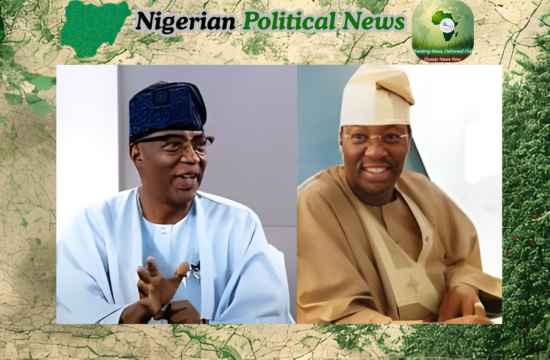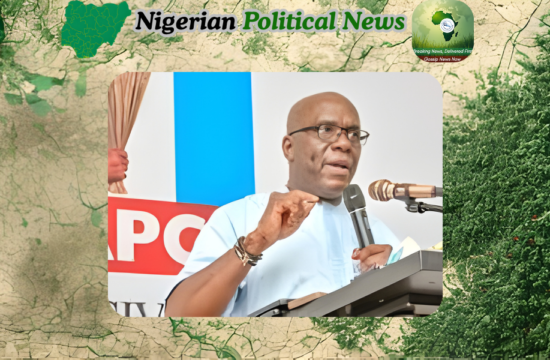

A senior figure in the All Progressives Congress (APC), Osita Okechukwu, has advised the African Democratic Congress (ADC) to tread carefully as it prepares for future elections, warning that abandoning the long-standing principle of political zoning could create serious internal problems for the party.
The former Director-General of the Voice of Nigeria (VON) made the remarks during a discussion with journalists in Abuja, where he reflected on the ongoing political turbulence within Nigeria’s opposition landscape.
Okechukwu pointed to the recent rejection by the Independent National Electoral Commission (INEC) of the faction of the Peoples Democratic Party’s National Working Committee associated with Tanimu Turaki. According to him, that development should serve as a cautionary example for other political organizations.
In his view, the situation surrounding the PDP demonstrates what can happen when internal party agreements and conventions are disregarded over time.
He argued that the electoral commission’s decision was not arbitrary but rather the outcome of prolonged disagreements and breaches of internal arrangements within the party structure.
The APC chieftain therefore warned that if the ADC fails to respect the political tradition of power rotation, it could encounter a crisis similar to the one currently affecting the PDP.
Okechukwu further stressed that the ADC should not attempt to shift blame toward the APC or President Bola Ahmed Tinubu if such problems arise in the future. According to him, the consequences would stem from the party’s own decisions.
In explaining his concerns, he highlighted the importance of allowing the southern region to complete what he described as the conventional eight-year tenure associated with Nigeria’s informal power-sharing arrangement.
He suggested that disregarding this understanding—particularly before the 2027 presidential election—could lead to significant political backlash and long-term consequences.
Okechukwu also reflected on earlier political developments involving the South-East, recalling that he had repeatedly advised Ndigbo against placing all their political expectations on a single political platform.
To support his argument, he referenced the 1999 presidential contest in which the PDP did not nominate one of its founding members and former Vice President, Dr. Alex Ekwueme, as its candidate.
He added that similar patterns of political miscalculations and perceived exclusion were visible in later elections held in 2003, 2007, 2011 and 2019, which he believes contributed to ongoing tensions within the party.
According to him, a comparable mistake could occur if the ADC assumes that it can rely on guaranteed electoral backing from northern voters.
Okechukwu questioned the assumption that the region would automatically deliver millions of votes to any particular candidate, stressing that political alliances and voter behavior are rarely predictable.
For him, the zoning system remains one of the key stabilizing mechanisms in Nigeria’s democratic system, especially given the country’s complex ethnic, religious and regional diversity.
Commentary and Analysis
The debate over zoning and power rotation has remained a recurring issue in Nigerian politics since the beginning of the Fourth Republic in 1999. While the arrangement is not written into the constitution, it has often served as a political understanding aimed at balancing power among the country’s regions.
Okechukwu’s warning reflects concerns that abandoning this informal agreement could reopen long-standing regional tensions. Political parties that fail to manage these sensitivities often face internal divisions that weaken their chances during elections.
For emerging political alliances like the ADC, maintaining internal unity while building national support may require careful navigation of these power-sharing expectations.
If the party ignores such conventions, it risks internal disagreements similar to those that have repeatedly troubled larger parties like the PDP.
© 2025 Gossip News Now, a division of CHIEJOS HARBIAN DIGITAL MEDIA LTD. Contact us via admin@gossipnewsnow.online