
Fresh political tension has emerged following strong remarks by a prominent member of Nigeria’s ruling party, who cautioned citizens against what he described as a dangerous opposition alliance capable of undermining national stability.
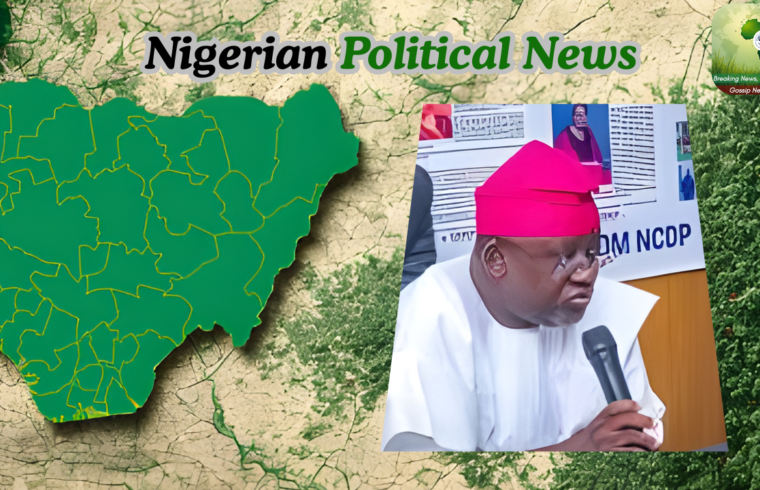
During a televised political programme, senior All Progressives Congress (APC) chieftain Biodun Ajiboye expressed deep concern over the activities of the African Democratic Congress (ADC), accusing the coalition of deliberately projecting negative narratives about the country. According to him, repeated criticisms coming from the group go beyond normal opposition politics and could weaken public confidence in government institutions.
Rather than beginning his argument with accusations, Ajiboye framed his concerns around national security and political responsibility. He suggested that Nigeria already faces complex threats ranging from insurgency to economic pressures, adding that political actors should avoid rhetoric capable of inflaming public anxiety. In his view, the country cannot afford additional internal instability created through coordinated political messaging.
Highlighting communication strategies used by governments worldwide, the APC stalwart defended the use of professional public relations services by authorities. He argued that seeking expert assistance to improve public engagement or international perception should not be interpreted as wrongdoing. For him, advocacy, lobbying, and reputation management remain legitimate democratic tools rather than acts deserving condemnation.
At another point in the discussion, Ajiboye compared Nigeria’s political climate with broader security challenges confronting the nation. He referenced ongoing battles against extremist groups to illustrate how fragile national cohesion can become when multiple pressures converge simultaneously. Within that context, he insisted that opposition coalitions must act responsibly when addressing sensitive national issues.
Rearranging his earlier remarks later in the conversation, the APC leader warned that citizens must remain vigilant about political alliances whose messaging, he believes, could damage Nigeria’s long-term prospects. He argued that portraying the country as collapsing or excessively distressed risks discouraging investors and eroding trust among Nigerians themselves.
Addressing claims about economic hardship raised by opposition voices, Ajiboye dismissed assertions that government communication efforts were wasteful. He maintained that strategic outreach and image management are sometimes necessary to prevent misinformation and reassure both domestic and international audiences during difficult periods.
He further suggested that the current administration had, in his opinion, steered Nigeria away from severe uncertainty that might have arisen under unpredictable leadership in the past. While he did not dwell on specific individuals, his comments implied that political stability required firm messaging and coordinated governance.
Commentary and Political Analysis
Ajiboye’s remarks reflect a widening divide between Nigeria’s ruling party and emerging opposition coalitions ahead of future electoral contests. His characterization of the ADC signals growing concern within the APC about alliances capable of consolidating dissenting political forces.
Analysts note that such sharp rhetoric often surfaces when political competition intensifies. By framing opposition criticism as potentially harmful to national unity, ruling party figures attempt to shift public debate from policy disagreements to questions of patriotism and stability. Conversely, opposition groups frequently argue that highlighting hardship and governance failures is essential in a democracy.
The debate also underscores a broader issue in Nigerian politics: the balance between constructive criticism and political messaging that may influence investor confidence, national morale, or international perception. As political actors continue to position themselves, public discourse is expected to remain heated in the months ahead.
Ultimately, Ajiboye’s warning illustrates how communication strategy, national security narratives, and economic realities have become deeply intertwined within Nigeria’s evolving political landscape.
© 2025 Gossip News Now , a division of CHIEJOS HARBIAN DIGITAL MEDIA LTD. Contact us via admin@gossipnewsnow.online