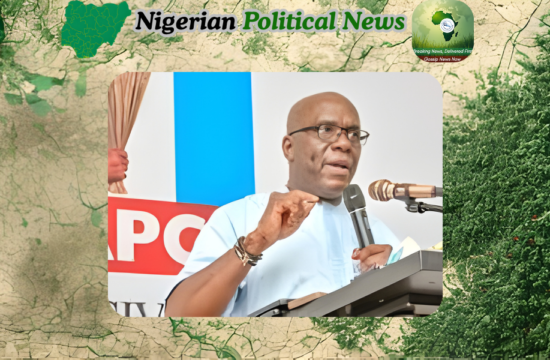


A senior member of the All Progressives Congress (APC), Alwan Hassan, has sparked political debate after making strong claims about the administration of former President Muhammadu Buhari. His remarks have drawn attention to issues surrounding governance and accountability during the former leader’s eight-year tenure.
Speaking during an appearance on Channels Television’s Politics Today, Hassan argued that the Buhari administration was heavily influenced by powerful internal networks often referred to as “cabals.” According to him, these groups allegedly operated with significant autonomy during the period.
Hassan suggested that many of the individuals who served in ministerial positions during Buhari’s presidency should face serious scrutiny over their conduct while in office.
During the interview, he specifically referenced prominent figures who held key roles in the administration, including former Attorney-General and Minister of Justice Abubakar Malami and former Minister of Labour Chris Ngige.
According to Hassan, a large number of ministers during that era enjoyed considerable freedom in managing their portfolios. He claimed the situation resulted in limited oversight and accountability in certain areas of government.
He further explained that this environment allowed officials to operate with unusual independence, creating what he described as a system where influence could easily develop around those who had direct access to the president.
Hassan noted that in some cases, gaining personal access to Buhari could translate into significant influence within government circles.
Despite his criticism, the APC chieftain acknowledged that not every official who served during the period should be grouped together. He emphasized that a small percentage of individuals carried out their duties responsibly.
However, he maintained that these cases were exceptions rather than the norm, suggesting that the overall governance environment at the time was characterized by weak supervision.
Another point raised by Hassan involved the management of government finances. He claimed that ministers often received their budget allocations without the type of close monitoring typically associated with presidential oversight.
He contrasted this situation with the current administration led by President Bola Tinubu, whom he described as more directly involved in financial and administrative decisions.
According to Hassan, Tinubu’s leadership style involves closer attention to government spending and policy implementation.
He also suggested that the current government is more cautious in handling public resources, noting that some contractors have complained about delays in payments because of stricter financial management processes.
For Hassan, these measures demonstrate a shift away from what he described as the relatively relaxed administrative environment that existed during Buhari’s presidency.
Commentary and Analysis
Hassan’s comments highlight an ongoing conversation in Nigerian politics about transparency and accountability in government. Allegations regarding the influence of informal power networks—often labeled as “cabals”—have surfaced repeatedly in discussions about several administrations.
Such claims typically reflect concerns about decision-making structures and whether official institutions fully control governance processes.
At the same time, comparisons between successive administrations are common in political discourse, especially when new governments attempt to differentiate their leadership styles from their predecessors.
The remarks may also reflect broader political dynamics within the APC, where members sometimes publicly debate the legacy of past administrations while evaluating the direction of current leadership.
Ultimately, statements like these often fuel public interest in issues of governance, accountability, and political reform, particularly as Nigeria continues to grapple with the challenge of strengthening democratic institutions.
© 2025 Gossip News Now , a division of CHIEJOS HARBIAN DIGITAL MEDIA LTD. Contact us via admin@gossipnewsnow.online