
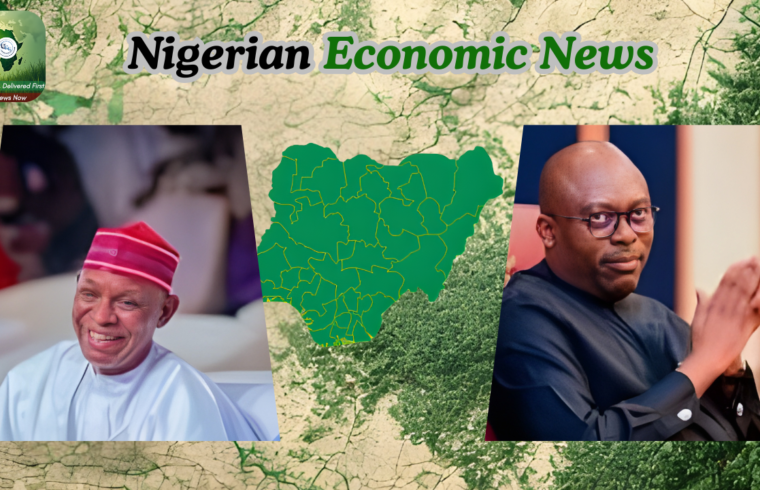
Fresh developments within the All Progressives Congress suggest that the political futures of Siminalayi Fubara and Abba Kabir Yusuf remain under negotiation rather than settled, despite growing speculation that both leaders could secure automatic tickets ahead of the 2027 elections.
Party insiders indicate that discussions surrounding their possible re-election bids are ongoing, with no binding agreement guaranteeing either governor a second-term nomination. Sources familiar with internal deliberations revealed that resistance from grassroots stakeholders and aspirants in both states has complicated expectations of automatic endorsement.
In Rivers State, political calculations intensified following Fubara’s departure from the Peoples Democratic Party. The defection was widely viewed as a strategic alignment move, yet it also reopened rivalry within the state’s political structure, particularly involving Nyesom Wike, whose influence continues to shape party dynamics.
Observers note that Wike’s public position — that electoral success cannot be assumed simply by joining the ruling party — has strengthened opposition within APC ranks against any pre-arranged ticket arrangement. Competing interests among local actors have therefore become a central obstacle to negotiations.
Meanwhile, Kano presents a different but equally complex scenario. Governor Yusuf’s exit from the New Nigeria Peoples Party alongside lawmakers and local government officials appeared to signal imminent entry into the APC. However, political fragmentation persists, as influential figures such as Rabiu Musa Kwankwaso remain outside the ruling party, leaving uncertainty over how unified support structures will evolve.
APC insiders maintain that multiple governorship hopefuls within both states are resisting perceived imposition. Their demand centres on competitive primaries rather than negotiated endorsements, arguing that internal democracy must guide candidate selection.
One senior party source explained that earlier political defections by governors from other parties were accompanied by informal assurances of political protection. In contrast, Rivers and Kano negotiations are described as more complicated due to entrenched alliances, rival ambitions, and concerns about electoral viability.
Within party leadership circles, the APC Governors’ Forum continues consultations with national executives regarding integration of new entrants. Nonetheless, divisions reportedly remain over whether Fubara and Yusuf possess sufficient political leverage to secure consensus support.
Analysts also highlight additional pressure points. In Kano, competing ambitions from figures such as Nasiru Yusuf Gawuna and Barau Jibrin add complexity to party calculations. In Rivers, Wike’s extensive political network is viewed as a decisive factor capable of influencing primary outcomes.
For now, party insiders insist that negotiations remain unresolved, emphasizing that eventual decisions will depend largely on state-level stakeholders rather than national declarations.
Reframed Political Developments
Instead of a guaranteed pathway, the situation currently reflects:
- Ongoing negotiations rather than confirmed endorsements
- Strong push for competitive party primaries
- Influence of regional political power blocs
- Internal evaluation of electoral strength before ticket allocation
Commentary & Analysis: Defection Politics And Party Power Dynamics
The unfolding situation underscores a recurring pattern in Nigerian politics: defection to a ruling party does not automatically translate into political security. While joining the APC may offer strategic advantages, local political ecosystems often determine ultimate outcomes.
Rivers and Kano illustrate how personality-driven politics, factional loyalty, and grassroots influence can outweigh national party calculations. The resistance to automatic tickets also signals growing insistence within parties on internal democracy — at least in principle.
If negotiations fail to produce consensus, both governors may face competitive primaries capable of reshaping political alliances ahead of 2027. Ultimately, the debate highlights a broader reality: political survival within Nigeria’s party system depends not only on party membership but also on negotiation power, stakeholder acceptance, and electoral credibility.
© 2025 Gossip News Now, a division of CHIEJOS HARBIAN DIGITAL MEDIA LTD. Contact us via admin@gossipnewsnow.online