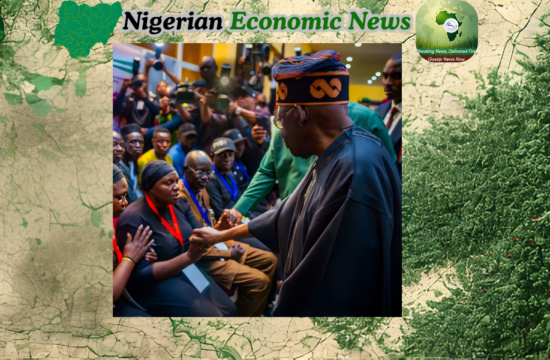

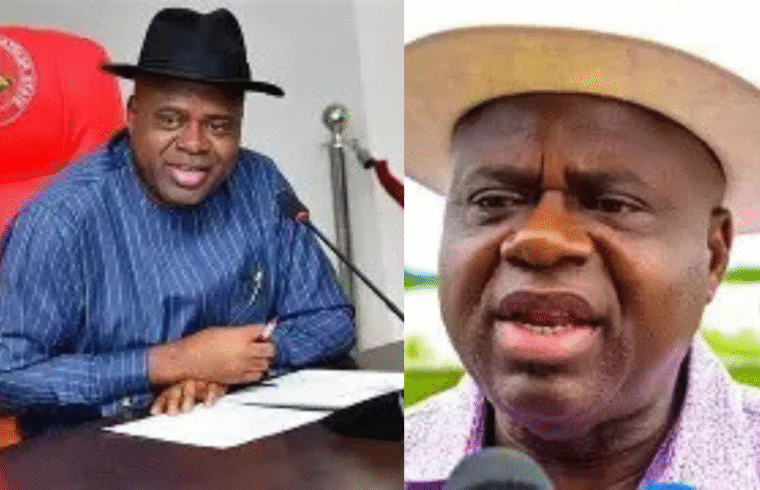
Bayelsa’s political atmosphere changed dramatically on November 3 when Governor Douye Diri formally exited the Peoples Democratic Party and aligned himself with the All Progressives Congress, a move that immediately triggered celebration among APC supporters and signaled a major shift in the state’s power structure.
The event in Yenagoa drew a massive crowd to the Samson Siasia Sports Complex, where party faithful gathered in large numbers despite the rain. The venue quickly filled up, security had to restrict further entry, and the city wore the mood of a political carnival as songs, chants, and party colours dominated the day.
Senior APC figures turned out in force for the occasion. Vice President Kashim Shettima represented President Bola Tinubu at the ceremony, while Senate President Godswill Akpabio and Progressive Governors Forum chairman Hope Uzodimma openly praised Diri’s decision. Several governors and top party chieftains were also present, underlining how seriously the ruling party viewed the governor’s arrival.
In his remarks, Diri presented his departure from the PDP as a deliberate move taken after deep reflection and consultations. He argued that the opposition party had become too unstable to guarantee political progress, insisting that he could not allow Bayelsa to remain tied to what he described as a weakening structure.
Gossip News Now reports that the governor did not frame the defection as a personal survival tactic alone. Instead, he linked it to wider political calculations involving the future of Bayelsa, the Ijaw nation, and his allies across elective offices. He maintained that his choice was made in what he believed to be the best long-term interest of the state.
Among the reasons he highlighted were the internal crisis within the PDP, the need to provide a more reliable platform for lawmakers seeking re-election, and his belief that the South-South political map had changed significantly. He also pointed to what he described as the supportive posture of President Tinubu toward Bayelsa, citing federal backing for projects such as the Lagos-Calabar Coastal Road, the Agge Deep Seaport, the Nembe-Brass Road, and tax relief connected to power infrastructure.
Diri further suggested that his relationship with the president and the federal government had helped open new doors for development. In his calculation, remaining outside the ruling party no longer made political or economic sense, especially if Bayelsa hoped to benefit from stronger federal cooperation and strategic investment.
The governor also moved to calm concerns about internal rivalry in his new political home, saying he came to build unity rather than dominate anyone. He expressed confidence that the APC in Bayelsa was ready to work together ahead of 2027 and revealed that a large part of the state’s political structure had moved with him, including most members of the House of Assembly, serving senators, council chairmen, and other influential figures.
His switch now stands as one of the most talked-about developments in the Niger Delta political landscape, because it goes beyond a party change and speaks to a broader reordering of alliances in a region long associated with the PDP. The symbolic and strategic weight of a sitting Bayelsa governor crossing over to the APC is likely to shape calculations well ahead of the next general election.
Commentary and Analysis
Diri’s defection is significant not only because of his office, but because of what it suggests about the weakening grip of old party loyalties in key states. When a governor in a traditionally PDP environment makes this kind of move, it often reflects both internal dissatisfaction and a desire to reposition before bigger national contests.
Another important angle is the development argument he used to justify the switch. By tying his decision to projects, federal cooperation, and Bayelsa’s future interests, Diri appears to be framing the move as practical governance rather than mere political ambition. That message may be crucial in persuading supporters who would otherwise view the decision with suspicion.
At the same time, the scale of those who reportedly moved with him points to the possibility of a deeper restructuring in Bayelsa politics. If that alignment holds, the APC may gain more than just a governor; it may have secured a stronger foothold in a region where it has historically fought for influence.
© 2025 Gossip News Now, a division of CHIEJOS HARBIAN DIGITAL MEDIA LTD. Contact us via admin@gossipnewsnow.online