

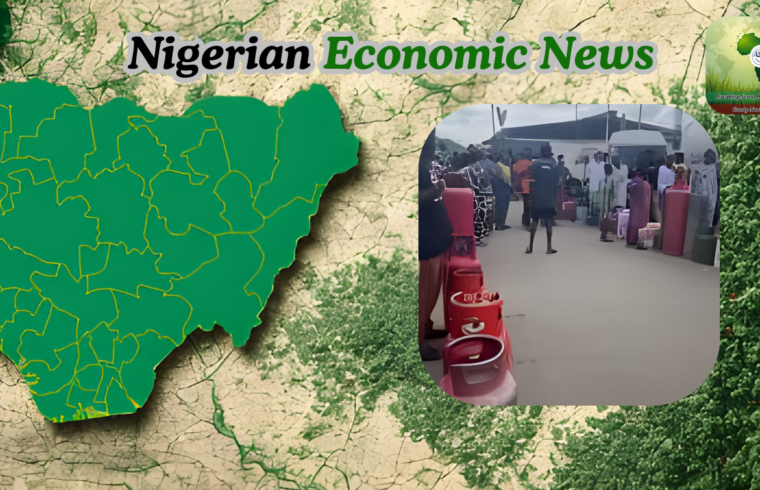
The National Bureau of Statistics (NBS) has released new figures showing a significant rise in the price of cooking gas across Nigeria in October 2025, with households paying noticeably more for refills compared to the previous month.
According to the bureau’s Cooking Gas Price Watch report, the average cost of refilling a 5kg cylinder climbed substantially within one month, reflecting growing pressure on domestic energy expenses for many Nigerian families.
Average Price of 5kg Cooking Gas Climbs
The NBS data indicates that the cost of refilling a 5kg gas cylinder rose from ₦6,395.82 in September to approximately ₦8,081.75 in October.
This increase represents a 26.36 percent rise within a single month, highlighting how quickly the cost of household energy can fluctuate.
When compared with figures recorded during the same period last year, the price also showed a considerable annual increase.
The bureau reported that the average price in October 2024 stood at ₦6,915.69, meaning the current cost reflects a year-on-year growth of 16.86 percent.
States With the Highest and Lowest Prices
The report revealed that cooking gas prices vary significantly depending on location, with some states paying far more than others.
Among the states surveyed, the highest average prices for a 5kg cylinder refill were recorded in:
- Borno — about ₦8,376.44
- Yobe — roughly ₦8,357.98
- Ondo — approximately ₦8,340.30
In contrast, the lowest prices were observed in:
- Bauchi — about ₦7,051.54
- Ebonyi — roughly ₦7,744.99
- Akwa Ibom — approximately ₦7,806.31
These variations demonstrate how regional supply conditions and distribution networks can influence energy costs.
Price Differences Across Geopolitical Zones
Beyond individual states, the report also analyzed cooking gas prices by geopolitical zones across the country.
The North-West region recorded the highest average price for the 5kg refill, reaching around ₦8,188.55.
The North-Central zone followed with an average price of ₦8,153.21, while the South-South region posted the lowest average figure at about ₦7,956.61.
12.5kg Cylinder Refill Costs Also Increase
The price rise was not limited to smaller cylinders. The cost of refilling a 12.5kg cylinder also increased during the same period.
Statistics show that the average price climbed from ₦16,155.09 in September to roughly ₦18,636.77 in October, representing a 15.36 percent month-on-month increase.
On an annual basis, the price also moved upward. The average cost for the same cylinder size in October 2024 was ₦16,734.55, indicating an 11.37 percent rise over the past year.
States With the Most Expensive 12.5kg Refills
The NBS report identified several states where the cost of refilling a 12.5kg cylinder was particularly high.
The three most expensive states were:
- Borno — about ₦19,391.57
- Yobe — around ₦19,339.51
- Ondo — approximately ₦19,289.65
Meanwhile, the lowest prices were found in:
- Ebonyi — roughly ₦17,610.88
- Akwa Ibom — around ₦17,783.79
- Anambra — among the states with relatively lower costs
Regional Comparison for 12.5kg Gas Refills
When the data is grouped by geopolitical zones, the North-East recorded the highest regional average price at about ₦18,953.86.
The North-West followed with an average cost close to ₦18,861.70, while the South-South region recorded the lowest average price at approximately ₦18,207.65.
Factors Behind the Price Increase
Several factors have been identified as contributing to the recent spike in cooking gas prices across the country.
Earlier industry reports indicated that the price per kilogram of cooking gas rose sharply across many retail outlets, increasing from roughly ₦1,100 per kilogram to as high as ₦1,800 per kilogram in some locations.
Officials from the Ministry of Petroleum Resources pointed to supply disruptions linked to two major developments.
The primary factors cited include:
- Industrial action by the Petroleum and Natural Gas Senior Staff Association of Nigeria (PENGASSAN) affecting operations at the Dangote Refinery
- Ongoing maintenance activities at the Nigeria LNG Train 4 facility
Both developments reportedly reduced supply levels temporarily, leading to higher retail prices nationwide.
Commentary and Analysis
The rising cost of cooking gas highlights the vulnerability of Nigeria’s energy market to supply disruptions and industrial actions.
Liquefied petroleum gas (LPG) has become an increasingly important energy source for households seeking cleaner alternatives to firewood and kerosene. However, price volatility can discourage adoption, particularly among lower-income households.
When supply chains are disrupted — whether through maintenance work, labour disputes, or infrastructure challenges — prices tend to react quickly due to Nigeria’s heavy reliance on imported and processed gas products.
If Nigeria hopes to stabilize cooking gas prices in the long term, experts say stronger domestic production, improved distribution infrastructure, and consistent industrial operations will be essential.
Until then, fluctuations in supply and logistics may continue to influence how much Nigerians pay for one of the country’s most important household fuels.
© 2025 Gossip News Now , a division of CHIEJOS HARBIAN DIGITAL MEDIA LTD. Contact us via admin@gossipnewsnow.online