

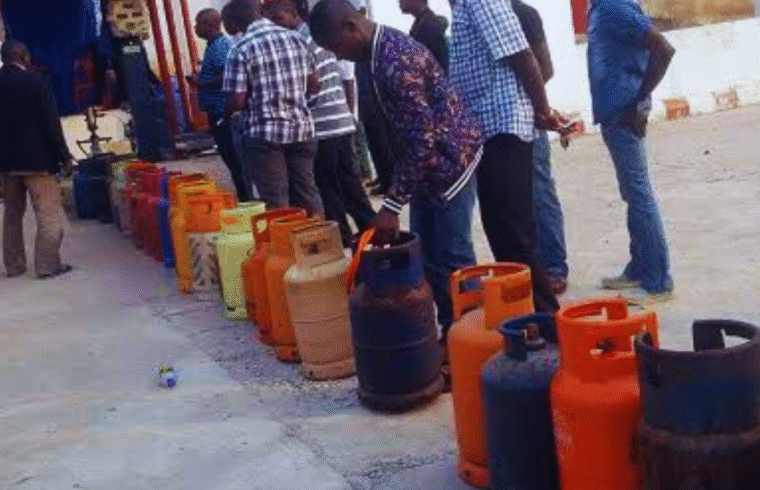
Despite recent assurances from the Federal Government, the cost of cooking gas has yet to ease in Abuja, with many consumers still paying steep rates for Liquefied Petroleum Gas across the city. Several residents and buyers say the promised relief has not translated into lower prices at the retail level.
A fresh survey showed that some roadside vendors are still selling LPG for as much as ₦1,800 per kilogram, even weeks after authorities moved to tackle the spike. This has continued to raise concern among households already struggling with the rising cost of living.
The current situation marks a major jump from the earlier average of about ₦1,100 per kilogram. The sharp increase followed disruptions linked to the strike embarked upon by the Petroleum and Natural Gas Senior Staff Association of Nigeria, which affected supply and triggered price pressure in the market.
To respond to the situation, the Federal Government instructed the Nigerian Midstream and Downstream Petroleum Regulatory Authority to intensify oversight at LPG depots across the country. The aim was to discourage hoarding and prevent artificial shortages that could worsen the crisis.
The Minister of State for Petroleum Resources (Gas), Dr. Ekperikpe Ekpo, explained that the surge came from a mix of supply setbacks. Among the issues he identified were the industrial dispute affecting the Dangote Refinery and ongoing maintenance at the NLNG Train 4 facility, both of which reduced the amount of gas available for local consumption.
Even so, the minister maintained that supply conditions were gradually improving. He noted that LPG loading activities for the domestic market had resumed at the Dangote Refinery, while other supply channels were also beginning to recover. He added that operations at the Bonny River Terminal managed by Seplat had restarted, with NLNG also working toward normal production levels.
Yet at the retail end, sellers argue that the impact of those improvements has not reached them quickly enough. Many insist they are still working with previously purchased stock obtained at inflated rates, making an immediate price cut difficult.
One retailer, Kingsley Paul, explained that a reduction would only happen when replacement stock becomes cheaper. In the same vein, a manager at a major gas plant said the outlet was still selling at around ₦1,450 per kilogram because much of its existing inventory had been bought when prices were at their peak. Gossip News Now reports that this gap between wholesale recovery and retail adjustment is one of the main reasons consumers are yet to feel relief.
Concern is also growing over what this could mean for Nigeria’s clean energy ambitions. With more households encouraged to move away from firewood, kerosene, and charcoal, experts say prolonged LPG inflation could slow that transition and push many families back to dirtier alternatives.
Environmental analyst Christian Chibuzor said cooking gas remains a better option for both public health and the environment because it reduces emissions and lowers exposure to smoke-related illnesses. However, he warned that if prices remain beyond the reach of ordinary Nigerians, especially those in rural communities, the broader push for cleaner energy may lose momentum.
Commentary and Analysis
The continued high cost of cooking gas highlights a familiar challenge in Nigeria’s energy market: government intervention may begin at the policy level, but the effect often takes longer to reach final consumers. While officials are pointing to improving supply conditions, traders are focused on the reality of expensive stock already in circulation. This means relief may come, but not as quickly as many households expect.
The issue also goes beyond market pricing. LPG is central to the country’s effort to promote safer and cleaner cooking methods. If affordability is not addressed in a lasting way, the government risks weakening public trust in that transition. For many families, the real test is not whether supply has resumed, but whether cooking gas becomes cheap enough to use consistently.
© 2025 Gossip News Now, a division of CHIEJOS HARBIAN DIGITAL MEDIA LTD. Contact us via admin@gossipnewsnow.online