

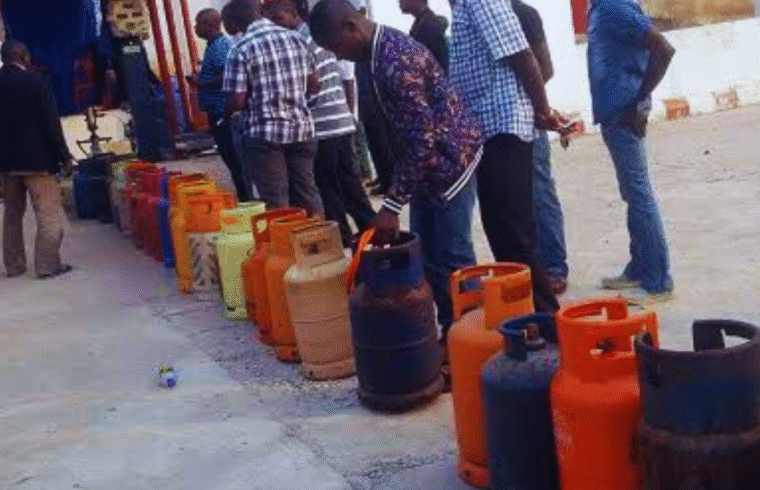
Many Nigerian households may soon experience some relief as the cost of cooking gas shows signs of declining in several parts of the country. Liquefied Petroleum Gas (LPG), commonly used for domestic cooking, had surged significantly in recent months, placing extra financial pressure on families already dealing with rising living costs.
Recent checks across major gas retail outlets suggest that the market is gradually adjusting downward. The shift follows weeks of unusually high prices that forced some households to reduce consumption or explore alternative cooking options.
According to Gossip News Now, a market survey conducted on Thursday revealed noticeable differences in the prices offered by various suppliers. At some retail stations operated by Conoil Plc, cooking gas is currently being sold for around ₦1,080 per kilogram. Meanwhile, outlets associated with Ardova Plc have been offering LPG at approximately ₦1,000 per kilogram.
Only a few weeks earlier, the situation had been far less encouraging for consumers. Many distributors were retailing cooking gas at prices close to ₦1,500 per kilogram, a spike that dealers explained was tied to previously purchased inventory acquired when wholesale costs were significantly higher.
The recent price movement has sparked cautious optimism among consumers. For many households, even a modest drop in gas prices can make a meaningful difference in weekly spending, particularly at a time when food and transportation costs remain high.
Estimated Cost of Refilling Gas Cylinders
Using the ₦1,080 per kilogram reference price reported in some outlets, the approximate refill costs for common cylinder sizes would appear as follows:
| Cylinder Size | Estimated Cost |
|---|---|
| 12 kg cylinder | About ₦12,960 |
| 5 kg cylinder | Roughly ₦5,400 |
| 1 kg refill | Around ₦1,080 |
| 12.5 kg cylinder | Approximately ₦13,500 |
| 10 kg cylinder | Near ₦10,800 |
| 3 kg refill | Close to ₦3,240 |
However, consumers should note that prices may differ depending on location, dealer margins, and supply conditions.
Government Response to Earlier Price Surge
Authorities have been monitoring developments in the LPG sector following the earlier surge in prices. The Federal Government had directed the Nigerian Midstream and Downstream Petroleum Regulatory Authority to intensify inspections at storage depots and distribution points.
The goal of the increased oversight was to discourage hoarding and ensure that available supplies reach the market in a timely manner.
During discussions on the issue, the Minister of State for Petroleum Resources (Gas), Ekperikpe Ekpo, explained that temporary supply disruptions contributed to the earlier price spike.
Two developments were highlighted as major causes. One was the industrial action by the Petroleum and Natural Gas Senior Staff Association of Nigeria which affected operations linked to the Dangote Refinery. Another factor involved scheduled maintenance work at Train 4 of the Nigerian Liquefied Natural Gas facility, which temporarily reduced local gas availability.
Despite those challenges, the minister reassured the public that supply conditions were gradually improving, suggesting that the market could stabilize if distribution continues without further disruptions.
Commentary and Market Outlook
Energy analysts say the cooking gas market in Nigeria remains sensitive to production levels, labor disputes, and infrastructure maintenance within the energy sector. Any interruption in supply chains—from production plants to distribution depots—can quickly influence retail prices.
The recent downward movement in LPG prices therefore reflects not only easing supply pressures but also adjustments by dealers who are gradually replacing older, higher-cost stock with newer inventory purchased at lower wholesale prices.
If supply continues to improve and regulatory oversight remains strong, many observers believe cooking gas prices could stabilize further in the coming months. For Nigerian households, such stability would be a welcome development in the broader effort to manage rising living expenses.
© 2025 Gossip News Now , a division of CHIEJOS HARBIAN DIGITAL MEDIA LTD. Contact us via admin@gossipnewsnow.online