
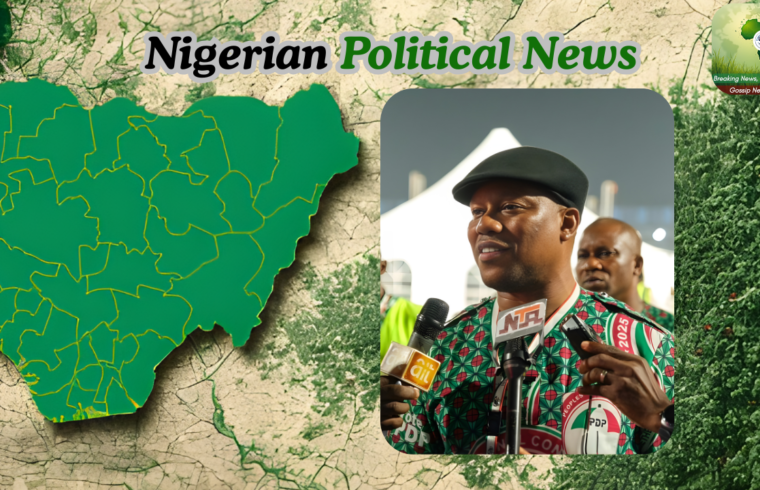
The National Publicity Secretary of the Peoples Democratic Party (PDP), Ini Ememobong, has called on the judiciary to approach disputes involving political parties with caution, warning that excessive court involvement in internal matters could raise concerns about neutrality.
Speaking during an appearance on Prime Time on Arise Television, Ememobong addressed recent legal developments affecting the party. His remarks followed a court decision that nullified a PDP convention held in Ibadan.
According to the party spokesman, the ruling has generated debate within political circles about the role of courts in resolving disputes that originate from within party structures.
He argued that the PDP’s constitution does not contain provisions for establishing a national caretaker committee, raising questions about the legal reasoning behind the decision.
Concerns About Judicial Neutrality
Ememobong explained that while the PDP continues to respect the judiciary as a key institution in Nigeria’s democratic system, it is important for courts to avoid actions that could create doubts about their impartiality.
He stressed that judicial independence must remain protected because public trust in the legal system is essential for maintaining confidence in democratic institutions.
According to him, situations where courts become deeply involved in internal political matters can sometimes create perceptions that undermine that trust.
Why Public Perception Matters
The PDP spokesman noted that there can be a difference between reality and how events are perceived by the public.
However, he warned that once public perception becomes strong enough, it can influence how people interpret the fairness of judicial processes.
Ememobong explained that even when no wrongdoing exists, certain developments can still trigger speculation among observers.
For this reason, he said, institutions must remain mindful of how their actions are interpreted by the public.
Reference to Publicised Meeting
During the interview, Ememobong pointed to reports of an interaction between the Chief Judge of the Federal High Court and the Minister of the Federal Capital Territory, Nyesom Wike.
According to him, the meeting, which reportedly involved discussions related to land and housing matters affecting members of the judiciary, received widespread publicity.
Although the PDP spokesman did not accuse anyone of misconduct, he noted that the visibility of the interaction could easily prompt questions from members of the public.
Key Points Raised by the PDP Spokesman
While discussing the situation, Ememobong highlighted several concerns regarding judicial involvement in political matters:
- Internal disputes within political parties should primarily be handled through party mechanisms.
- Courts must remain cautious to avoid perceptions of bias or partiality.
- Public confidence in the judiciary depends on both fairness and the appearance of fairness.
- Highly publicised interactions involving judicial officials and political figures can raise questions, even when no wrongdoing exists.
He stressed that maintaining the credibility of the judiciary is essential for the stability of the country’s democratic system.
Justice Must Be Seen to Be Fair
Ememobong concluded by emphasizing a widely accepted principle within democratic societies—that justice should not only be done but must also be seen to be done.
According to him, safeguarding this principle is crucial for preserving confidence in the courts.
He said that when judicial neutrality is protected, it strengthens the rule of law and reinforces the legitimacy of democratic processes.
Commentary and Political Analysis
The remarks from the PDP spokesman highlight the delicate relationship between politics and the judiciary in Nigeria’s democratic system.
Political parties frequently turn to the courts to resolve internal disputes, particularly when disagreements arise over leadership, conventions, or candidate selection.
However, such cases can place the judiciary in sensitive positions where its decisions inevitably attract political interpretation.
Analysts note that maintaining judicial independence while resolving political disputes requires careful balancing.
If courts are perceived as interfering too deeply in internal party matters, it may fuel debates about impartiality. On the other hand, refusing to adjudicate disputes could leave political conflicts unresolved.
Ememobong’s comments therefore reflect a broader discussion about the appropriate boundaries between legal intervention and political autonomy within Nigeria’s party system.
© 2025 Gossip News Now, a division of CHIEJOS HARBIAN DIGITAL MEDIA LTD. Contact us via admin@gossipnewsnow.online