

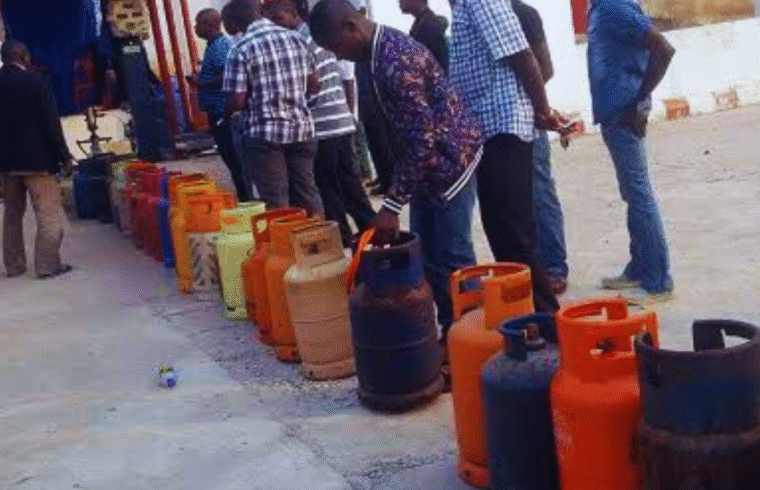
Across Nigeria, the cost of Liquefied Petroleum Gas (LPG)—commonly used for cooking—has remained unstable, creating financial pressure for many households already grappling with rising living expenses. What used to be a relatively affordable domestic fuel is now becoming a growing concern for families trying to manage their daily needs.
Recent observations from various markets indicate that the average cost of cooking gas hovers around ₦1,050 per kilogram. However, this figure is not uniform nationwide, as some areas report significantly higher prices, reaching up to ₦1,500 per kilogram depending on location and vendor pricing structures.
This uneven pricing trend has intensified the burden on consumers. Families that are already dealing with increased food prices and general inflation now find themselves allocating more funds just to refill their gas cylinders, further stretching limited incomes.
Estimated Refill Costs Based on Cylinder Sizes
Using the average rate of ₦1,050 per kilogram, the cost of refilling different cylinder sizes can be outlined as follows:
- Smaller cylinders such as 1kg require just over ₦1,000 to refill
- A 3kg cylinder costs slightly above ₦3,000
- For 5kg cylinders, consumers spend over ₦5,000
- Medium-sized 10kg cylinders exceed ₦10,000
- Larger household sizes like 12kg and 12.5kg go beyond ₦12,000
These estimates may vary depending on regional pricing differences and dealer charges.
Key Drivers Behind the Rising LPG Prices
Several underlying factors contribute to the persistent increase and variation in cooking gas prices:
One major influence is the cost at which gas is supplied at depots. Since retailers depend heavily on depot pricing, any increase at that level directly impacts what consumers pay.
Another contributing factor is transportation. The rising cost of diesel and logistics significantly affects the distribution of gas, especially to remote or inland areas where delivery expenses are higher.
Currency fluctuations also play a role. As the naira weakens against foreign currencies, the cost of importing LPG and related equipment increases, ultimately affecting retail prices.
Demand and supply dynamics further complicate the situation. Regions experiencing higher demand or limited supply often face sharper price increases compared to better-supplied areas.
In addition, independent dealers typically include their own margins to cover operational costs, which further drives up the final price consumers encounter.
Market Insight and Analysis
According to Gossip News Now, the current situation reflects a broader economic challenge rather than a temporary market shift. The steady rise in LPG prices highlights the need for improved local production, better distribution networks, and policies that can stabilize the energy sector.
Without targeted interventions, many households may begin to explore alternative cooking methods, some of which may not be environmentally friendly or safe. This could reverse the progress made in promoting cleaner energy usage across the country.
© 2025 Gossip News Now, a division of CHIEJOS HARBIAN DIGITAL MEDIA LTD. Contact us via admin@gossipnewsnow.online