
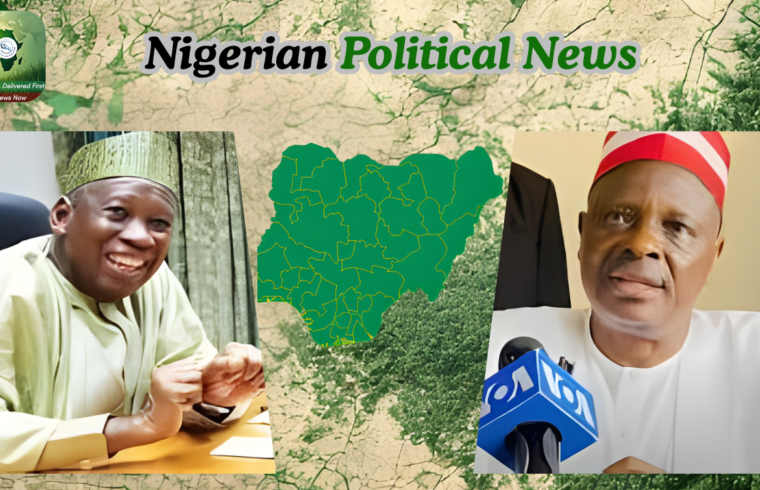
Fresh tensions have emerged in Kano’s political landscape following remarks attributed to Senator Rabiu Musa Kwankwaso, which reportedly angered former governor Abdullahi Umar Ganduje. The reaction highlights how fragile political relationships remain in the state despite growing calls for reconciliation among key stakeholders.
The concerns became public through Baffa Babba Dan’agundi, Director-General of the National Productivity Centre, who disclosed that Ganduje personally expressed frustration over the tone and implications of Kwankwaso’s comments. According to him, the former APC national chairman did not hide his disappointment, especially after hearing reports that he was described in adversarial terms while Kwankwaso addressed his followers.
Dan’agundi explained that Ganduje viewed the labeling as unjustified and unhelpful, particularly given Kano’s current need for political stability. He stressed that such characterizations only deepen divisions at a time when collaboration should be the priority. Ganduje reportedly conveyed the sentiment that unnecessary hostility undermines collective efforts aimed at improving governance and public welfare.
Interestingly, the exchange unfolded alongside broader accusations involving Kano’s political structure. Kwankwaso had raised concerns about alleged attempts by the administration of Governor Abba Kabir Yusuf to consolidate influence across state institutions, a claim that has added another layer of complexity to the already tense political environment.
Despite these disagreements, Ganduje appears to favor reconciliation over escalation. Through his associate, he emphasized that if Governor Yusuf decides to align with the All Progressives Congress, it should serve as a chance to rebuild trust rather than reopen old political wounds. This possible development has reportedly generated optimism among APC members, who see it as an opportunity to strengthen unity.
Plans are already being quietly developed to formally receive the governor back into the party structure, though logistical challenges have slowed progress. Dan’agundi noted that some key figures, including Kano APC chairman Abdullahi Abbas, as well as Ganduje himself, were temporarily unavailable due to travel commitments. Once consultations resume, a formal engagement is expected to set the stage for any potential political realignment.
Beyond party strategy, Ganduje’s position appears shaped by his belief that experience and maturity should guide political conduct. He reportedly expressed the view that both he and Kwankwaso have reached a phase in their careers where mentorship and stability should outweigh rivalry. According to Dan’agundi, Ganduje questioned the value of prolonging disputes when both men have contributed significantly to Kano’s political history.
He further emphasized that Kano’s progress depends on cooperation among influential leaders, regardless of party affiliation. Ganduje’s message, as relayed, was clear: unity offers greater benefits than prolonged confrontation, especially at a time when the public expects tangible improvements in governance and development.
Commentary and Political Analysis
The situation underscores a familiar pattern in Kano politics, where longstanding rivalries often resurface during moments of political transition. Ganduje’s measured response suggests a strategic effort to position himself as a unifying figure rather than an aggressor. This approach could strengthen his influence within the APC and beyond, particularly if Governor Yusuf’s rumored return materializes.
At the same time, Kwankwaso’s influence remains significant, and his statements continue to shape political narratives across the state. The interplay between both leaders reflects the broader struggle for political relevance and legacy in Kano. However, Ganduje’s emphasis on reconciliation may signal a shift toward more pragmatic politics, where alliances are shaped less by past disagreements and more by present realities.
Ultimately, the coming months may determine whether Kano’s political heavyweights can move beyond rivalry to embrace cooperation. If reconciliation efforts succeed, the state could enter a new phase defined by stability and coordinated development rather than prolonged political tension.
© 2025 Gossip News Now , a division of CHIEJOS HARBIAN DIGITAL MEDIA LTD. Contact us via admin@gossipnewsnow.online