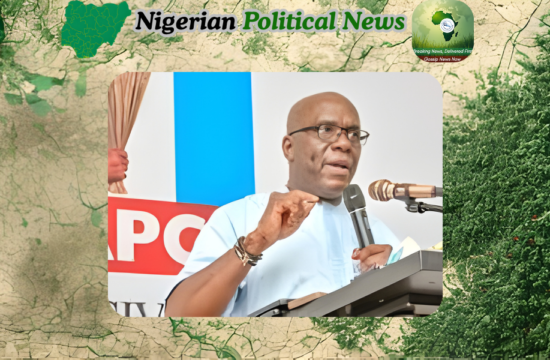

Former presidential aspirant Gbenga Hashim has dismissed concerns that recent political developments could weaken the Peoples Democratic Party, insisting that Nigeria’s democratic structure is strong enough to withstand attempts to undermine opposition parties.
In a statement addressing the country’s evolving political climate, Hashim argued that the nation’s commitment to a multiparty system makes it impossible for any single political group to dominate the political landscape permanently.
He also criticized what he described as subtle legal and political tactics allegedly aimed at weakening the PDP, warning that such strategies would ultimately fail.
According to him, Nigeria’s political history demonstrates a consistent pattern of pluralism rather than concentration of power.
Hashim explained that the country’s founders deliberately adopted a multiparty political structure to accommodate Nigeria’s diversity and protect democratic competition.
Reflecting on the early years of independence, he pointed out that the First Republic featured several influential political movements operating simultaneously across different regions.
For instance, Northern Nigeria witnessed the presence of multiple parties and leaders rather than a single dominant force.
These included:
- Ahmadu Bello and the Northern People’s Congress
- Aminu Kano and the Northern Elements Progressive Union
- Joseph Tarka with the Middle Belt Congress
Hashim also highlighted that other regional political organizations existed in the North, including the Borno People’s Union associated with Kashim Ibrahim.
The South-West region experienced a similar political landscape during that era.
According to him, the Action Group competed actively with the National Council of Nigerian Citizens as well as regional platforms like the Ibadan People’s Party.
By referencing these examples, Hashim argued that Nigeria’s political system has never been structured around a single dominant party.
He described the country’s democratic environment as one that thrives on a variety of political voices rather than uniform control.
To reinforce his argument, the former presidential candidate drew a historical comparison with events during the military era.
He recalled the political manoeuvre by late military ruler Sani Abacha, who once attempted to emerge as the sole presidential candidate supported by all registered political parties.
Hashim noted that the attempt ultimately collapsed and never materialised, describing it as a lesson about the resilience of Nigeria’s political system.
In his view, the current political climate may show signs of tension, but it does not signal the end of multiparty democracy in the country.
He expressed confidence that any attempt to weaken political pluralism would eventually collapse in the same way previous efforts did.
Hashim also shared personal reflections about his involvement in Nigeria’s pro-democracy struggle during the years of military rule.
He explained that many of the efforts to defend democracy were carried out within Nigeria by activists and political actors who remained in the country.
According to him, he was among those present during critical discussions at Fort IBB on June 8, 1998, when tensions were high and military activities threatened the country’s political stability.
Looking back at that period, Hashim said the experience strengthened his belief that Nigeria’s democratic institutions are capable of surviving political pressure.
Commentary and Analysis
Gbenga Hashim’s remarks highlight the enduring debate about political balance in Nigeria’s democratic system.
Multiparty democracy has been a defining feature of Nigeria’s political structure since independence, with different regions historically supporting various political movements.
However, the country has also experienced periods when dominant parties appeared to overshadow smaller opposition groups.
Hashim’s reference to the Abacha era underscores the importance of historical memory in Nigerian politics, where past struggles against authoritarian rule continue to shape public expectations.
The discussion also reflects broader concerns about maintaining a healthy democratic environment where multiple parties can compete freely.
As Nigeria approaches future elections, the resilience of opposition parties and the ability of the political system to accommodate diverse viewpoints will likely remain central to debates about the country’s democratic future.
© 2025 Gossip News Now, a division of CHIEJOS HARBIAN DIGITAL MEDIA LTD. Contact us via admin@gossipnewsnow.online