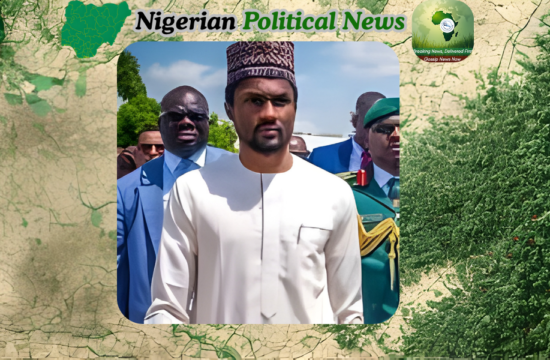


Former pension reform chairman Abdulrasheed Maina has returned to public attention after appearing at a legal community event in Abuja where he received a recognition award, years after his conviction over a major pension fraud scandal.
The unexpected appearance drew widespread reactions, largely because Maina had maintained a low public profile following his sentencing for financial crimes connected to misappropriated pension funds. His participation in the ceremony, organised by the Garki branch of the Nigerian Bar Association, marked one of his first visible engagements since regaining freedom.
During the Abuja gathering, he was presented with an honour described as celebrating commitment to the rule of law and courage. Observers noted that he attended wearing attire identifying him as a patron linked to the association’s local branch, a detail that immediately triggered discussion among attendees and the wider public.
Fresh Allegations and Calls for Investigation
Rather than limiting his remarks to appreciation for the award, Maina used the platform to raise new accusations against former Attorney General Abubakar Malami. He argued that deeper investigations into past government actions could lead to additional recovery of public funds.
According to him, certain developments during the previous administration were never properly examined, insisting that renewed scrutiny would expose further financial irregularities. His comments came amid ongoing legal proceedings involving Malami and members of his family, who face prosecution by the Economic and Financial Crimes Commission over alleged financial offences.
Reports indicate that the former minister and his relatives had earlier faced detention before securing bail, though law enforcement agencies later conducted additional arrests connected to the case.
Maina Maintains Innocence
Despite his earlier conviction, Maina reiterated claims that he was wrongly prosecuted. He alleged that influential figures within the administration of former President Muhammadu Buhari orchestrated circumstances that led to his legal troubles.
He recounted events surrounding his controversial absence from court proceedings years ago, stating that he travelled abroad for medical treatment before eventually being arrested in the Niger Republic and returned to Nigeria to face trial.
His statements revived long-standing debates surrounding accountability, political influence, and the handling of high-profile corruption cases in Nigeria.
The Pension Fraud Case Revisited
Maina first rose to prominence in 2010 when he was appointed under President Goodluck Jonathan to lead reforms aimed at sanitising the pension system through nationwide verification exercises.
Investigations later uncovered an elaborate network of alleged financial misconduct involving fake contracts, proxy companies, and multiple bank accounts used to divert billions of naira meant for retirees. A corporate entity linked to him was convicted alongside him and ordered to be wound up by the court.
During trial proceedings, testimonies from family members reportedly revealed how identities were used to operate accounts connected to the transactions under investigation.
In November 2021, a Federal High Court judgment sentenced Maina to eight years’ imprisonment for laundering over ₦2 billion. The verdict, later affirmed on appeal, also resulted in heavy asset forfeitures, including dozens of properties transferred permanently to the Federal Government. His son received a separate prison term tied to related offences.
Sources familiar with correctional records indicate that Maina quietly completed his sentence and regained freedom in early 2025, though official confirmation of the exact release date was not widely publicised.
Commentary & Analysis
Maina’s public re-emergence highlights a recurring challenge within anti-corruption efforts: how societies respond when convicted public officials return to civic spaces after serving their sentences. Legally, completion of punishment restores certain rights, yet public perception often remains shaped by past controversies.
The award presentation has sparked questions about institutional memory, rehabilitation, and the criteria used by professional organisations when recognising individuals with controversial histories. Supporters may argue that reintegration after punishment aligns with principles of justice, while critics view such recognition as potentially undermining accountability.
Beyond the individual case, the episode reflects broader tensions in Nigeria’s anti-corruption narrative—where prosecutions, political rivalries, and public trust intersect. As corruption cases continue to dominate national discourse, moments like this reignite conversations about transparency, redemption, and institutional credibility.
Maina’s return to public visibility therefore represents more than a personal comeback; it underscores the complex relationship between justice served and reputation restored in contemporary Nigerian politics.
© 2025 Gossip News Now , a division of CHIEJOS HARBIAN DIGITAL MEDIA LTD. Contact us via admin@gossipnewsnow.online