
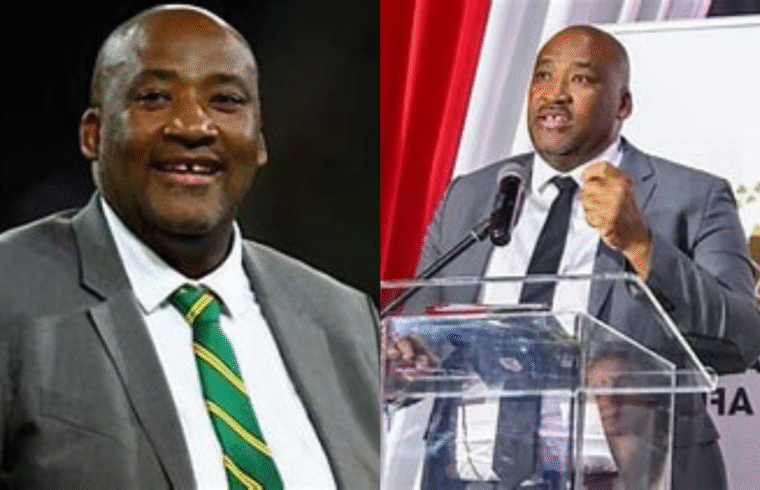
Fresh controversy has erupted in African football circles after Gayton McKenzie, South Africa’s Minister of Sport, Arts and Culture, openly declared that he does not want Nigeria’s Super Eagles to feature at the 2026 FIFA World Cup. His comments have fueled tension between two of the continent’s biggest footballing nations.
The statement surfaced during a conversation shared by journalist Robert Marawa, where the minister reacted strongly to events surrounding the recent qualification process. His frustration appears to be linked to disputes that unfolded during the campaign, particularly involving eligibility concerns.
According to Gossip News Now, the situation escalated when South Africa faced sanctions for fielding a player who did not meet qualification requirements in a match against Lesotho. The decision resulted in a deduction of points and goals, a development that influenced the standings in their group.
Nigeria’s involvement in raising formal objections to FIFA reportedly intensified the matter. While the disciplinary action did not ultimately cost Bafana Bafana their top position in Group C, it left lingering resentment among some South African officials.
In a rephrased expression of his stance, Gayton McKenzie made it clear that he holds no intention of backing Nigeria’s qualification bid. He suggested that other African nations should take the available slots instead, emphasizing his dissatisfaction with what he believes occurred behind closed doors.
Despite the controversy, both teams remain on different paths. Bafana Bafana, guided by Hugo Broos, have already secured their place at the global tournament, marking a significant milestone since their last appearance on home soil in 2010.
On the other hand, Nigeria’s Super Eagles are still in contention and must navigate a more challenging route. Their journey involves upcoming CAF play-offs, with the possibility of advancing to intercontinental qualifiers if they succeed.
Analysis: Rivalry, Politics, and African Representation
The remarks from Gayton McKenzie highlight how football rivalries can extend beyond the pitch into administrative and political spaces. While competitive tensions are not uncommon, such public statements from high-ranking officials can deepen divisions within African football.
At the same time, the situation underscores the importance of regulatory compliance in international competitions. The penalties faced by South Africa demonstrate how technical decisions can significantly impact qualification outcomes.
For Nigeria, the focus remains on performance and securing a place at the 2026 FIFA World Cup, regardless of external opinions. The unfolding drama, however, adds another layer of intrigue to Africa’s road to the tournament.
© 2025 Gossip News Now, a division of CHIEJOS HARBIAN DIGITAL MEDIA LTD. Contact us via admin@gossipnewsnow.online