

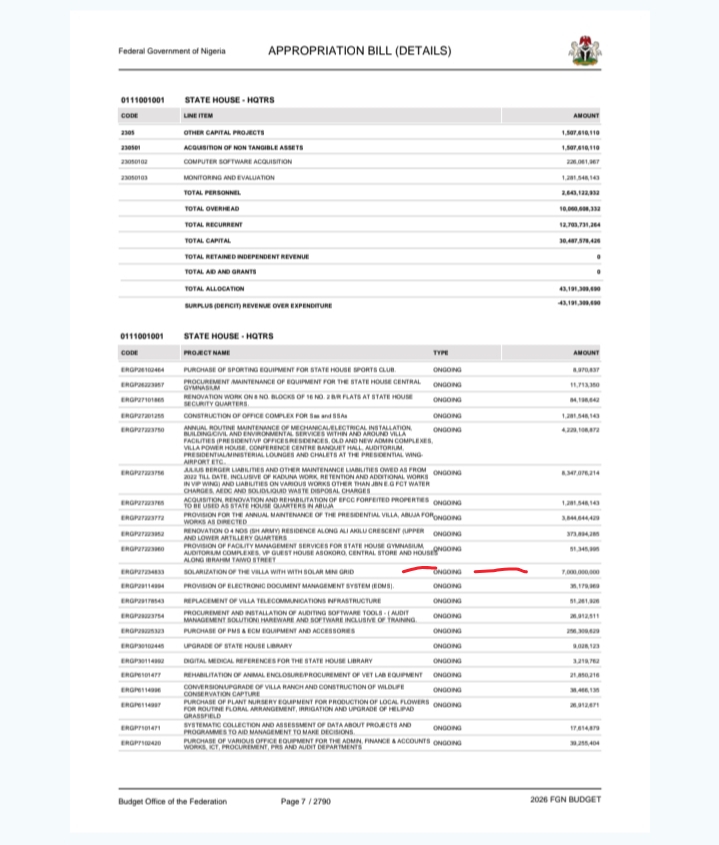
The administration of President Bola Tinubu has earmarked ₦7 billion for the solarisation of the Presidential Villa, continuing a similar initiative that began in 2025.
Sahara Reporters reports that the new allocation, listed under the State House expenditures for the 2026 fiscal year, is intended to fund the installation of a solar mini-grid for the Villa, which accommodates the President and top government officials.
The ₦7 billion budget line appears as the “provision of solarisation of Villa with solar mini-grid” in the recently released Budget Office of the Federation documents.
This follows a ₦10 billion investment in 2025 for the same purpose, marking the government’s ongoing focus on renewable energy solutions for Aso Rock.
Public Backlash Over Timing and Priorities
The announcement has sparked criticism, with many questioning the timing of the project given Nigeria’s persistent power shortages and economic challenges. Critics argue that the administration should prioritise reliable electricity access for the general population rather than focus on the Villa.
Presidential spokesperson Bayo Onanuga defended the initiative, describing it as a long-term investment in sustainability and energy efficiency.
“The White House in Washington D.C. uses solar power. We are not reinventing the wheel. We are following a tested and globally accepted model for powering important national institutions sustainably,” Onanuga said.
Nigeria’s Power Crisis Continues
The move comes amid severe electricity shortages nationwide. In April 2025, Nigeria’s national grid experienced a major collapse, leaving much of the country without power.
Data from the Nigerian Independent System Operator (NISO) showed electricity generation falling from over 2,000 MW to just 139.92 MW within an hour, causing widespread blackouts.
The grid collapsed again in September 2025, affecting major cities, including Lagos, highlighting the fragility of the national electricity system. Even after a brief surge to 6,000 MW in March 2025, power output fell sharply below 1,000 MW, underscoring ongoing challenges.
Citizens continue to demand stable electricity for homes, businesses, and critical services, raising questions about the government’s energy priorities in the face of recurring outages.
© 2025 Gossip News Now, a division of CHIEJOS HARBIAN DIGITAL MEDIA LTD. Contact us via admin@gossipnewsnow.online