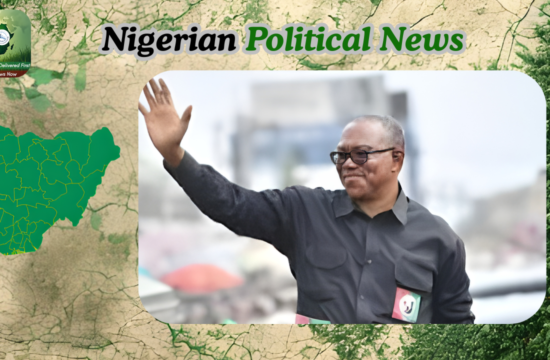


A major political transition is unfolding in Kano State as visible changes at the Government House signal Governor Abba Kabir Yusuf’s imminent entry into the All Progressives Congress (APC). The transformation became evident when the red-and-white colours associated with the New Nigeria Peoples Party (NNPP) disappeared from official premises, replaced by APC symbols across strategic locations.
By Monday morning, observers noted that party flags belonging to the ruling APC had already taken prominent positions at entrances and administrative sections of the complex, creating a strong impression that control of the state’s political structure was shifting even before the governor’s formal announcement.
Security arrangements were reportedly intensified around the Government House as preparations advanced for a large political reception expected to accompany Yusuf’s declaration. The event is planned to coincide with the rollout of the APC’s electronic membership registration initiative in Kano, a timing widely interpreted as symbolic of consolidation rather than mere defection.
Events Leading to the Political Switch
Speculation surrounding the governor’s movement had circulated for weeks, particularly after a private engagement between Yusuf and President Bola Tinubu at the Presidential Villa in Abuja. Although details of the meeting were not officially disclosed, the encounter strengthened public belief that negotiations over political alignment were already at an advanced stage.
Sources familiar with earlier developments suggested that discussions about the governor’s long-term political future contributed to delays in announcing the move. Reports hinted at negotiations tied to electoral assurances, including considerations connected to future governorship ambitions.
Confirmation eventually came through an official communication issued by Yusuf’s media office, revealing that he had formally resigned from the NNPP days before the anticipated declaration ceremony. The announcement effectively ended speculation and set the stage for a dramatic political realignment in one of Nigeria’s most influential northern states.
A Return Rather Than a New Beginning
Interestingly, the governor’s relationship with the APC is not entirely new. Historical accounts indicate that Yusuf was previously associated with the party during its formative political contests. He once secured victory in an APC senatorial primary for Kano Central before stepping aside to support Rabiu Musa Kwankwaso, who later pursued the election under the Peoples Democratic Party (PDP).
This background has allowed supporters of the move to frame the defection as a political homecoming rather than an ideological shift, suggesting continuity in alliances that have evolved over time.
Political Implications for Kano State
The replacement of NNPP insignia with APC branding carries symbolic weight beyond aesthetics. Kano remains a key electoral stronghold in Nigeria’s political arithmetic, and control of the Government House significantly strengthens the ruling party’s influence in the region.
Analysts believe the development could reshape local political dynamics, potentially weakening opposition structures while expanding the APC’s organisational reach ahead of future elections.
The timing of the announcement alongside membership registration activities also signals a broader mobilisation strategy aimed at integrating existing political supporters into the APC framework quickly and efficiently.
Commentary & Political Analysis
Governor Yusuf’s defection illustrates how Nigerian politics often revolves around strategic alliances rather than rigid party loyalty. Political actors frequently reposition themselves to maintain relevance within evolving national power structures.
For the APC, absorbing a sitting governor from a rival platform represents both a symbolic and practical victory. It reinforces perceptions of growing dominance while simultaneously raising questions about the sustainability of smaller opposition parties struggling with internal cohesion.
However, such transitions can produce mixed reactions among voters. While some see the move as pragmatic governance aligned with federal power, others may interpret it as evidence of ideological fluidity in Nigerian party politics.
Ultimately, the long-term impact will depend on whether the political realignment translates into tangible governance outcomes for Kano residents. As events unfold, the state may serve as an important case study on how defections influence democratic competition and party consolidation nationwide.
© 2025 Gossip News Now , a division of CHIEJOS HARBIAN DIGITAL MEDIA LTD. Contact us via admin@gossipnewsnow.online