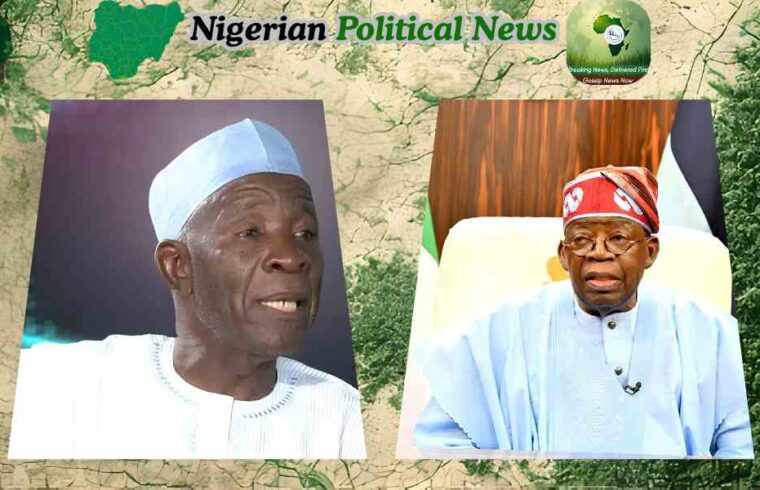
Buba Galadima has called for Nigerians to unite against President Bola Tinubu in the 2027 election, alleging that the president is protecting himself and the All Progressives Congress (APC) while making it difficult for opposition parties to produce candidates.
The Nigeria Democratic Congress (NDC) chieftain made the statement during the inauguration of the party’s National Reconciliation Committee, an initiative established to resolve disputes that emerged from its recent congresses, convention and primaries.
Galadima’s intervention therefore came at a significant point for the opposition party: while he was calling for a united political effort against Tinubu ahead of 2027, the NDC was itself beginning a process aimed at resolving disagreements within its ranks.
Galadima’s Warning
Galadima alleged that Tinubu was using his position to protect himself and the APC and to make it harder for other political parties to produce candidates capable of challenging him.
He also claimed that the Electoral Act had been designed and perfected by Tinubu before it was presented to the National Assembly.
According to Galadima, the president was not approaching the 2027 election as a conventional contest between political candidates.
“Tinubu is only protecting himself and the APC and making it difficult for other parties to produce candidates,” he said.
He added that Nigerians would have to come together to prevent Tinubu from remaining in power.
“The president is not thinking of a contest with anybody, but we won’t allow it. Even if it’s an empty coffin, all Nigerians must come together and throw him out for the sake of this country,” Galadima said.
The claims are Galadima’s allegations and the material provided does not independently establish them as facts.
The Other Battle Inside The Opposition
The setting in which Galadima made the remarks is significant.
The NDC had just inaugurated a National Reconciliation Committee to address disputes involving aspirants and stakeholders following its nationwide congresses, convention and primaries.
The committee was created as part of efforts to resolve grievances and litigation arising from those internal processes, with the party looking to restore unity ahead of the 2027 general elections.
Former presidential candidate Pat Utomi was appointed to chair the committee.
Utomi said the assignment was both a privilege and a major responsibility, expressing confidence that the committee could bring aggrieved members back together and allow the party to concentrate on the country’s future.
That reconciliation effort provides an important backdrop to Galadima’s call for broader opposition unity.
Galadima And Utomi On The Same Political Ground
Utomi also addressed his longstanding political disagreements with Galadima.
Despite their differences over the years, he said their relationship remained cordial.
His comments offered a more conciliatory tone at an event where the NDC was attempting to repair divisions created by its internal electoral processes.
The committee’s task is therefore not limited to settling individual grievances. Its broader purpose is to help the party move beyond the disputes surrounding its recent congresses, convention and primaries.
For a party preparing for the 2027 political contest, that internal process is closely connected to the question of how effectively it can present itself as a united opposition force.
What Galadima’s Call Means For 2027
Galadima’s message places opposition unity at the centre of his argument for defeating Tinubu.
His criticism suggests that, in his view, opposition parties cannot afford to approach 2027 as isolated political organisations if they hope to challenge the incumbent.
But the NDC’s reconciliation exercise highlights the difficulty of achieving that unity.
The party is still working to resolve disagreements among its own members arising from its internal electoral processes. Until those disputes are addressed, calls for wider opposition cooperation remain tied to the more immediate challenge of maintaining cohesion within individual parties.
This gives the reconciliation committee headed by Utomi a significance beyond the disputes that led to its creation.
The Claims And The Political Record
Galadima’s assertions about Tinubu, the APC and the Electoral Act remain political claims made by the NDC chieftain.
The supplied material does not include a response from Tinubu or the APC to the allegations, nor does it independently establish Galadima’s claim that the president is making it difficult for opposition parties to produce candidates.
His statement about the Electoral Act is likewise presented as his allegation.
The distinction matters as political parties begin positioning themselves for 2027, particularly when claims about the fairness of the political process could shape public perception of the election before campaigns fully develop.
What Happens From Here
For the NDC, the immediate task is to address the disagreements that followed its congresses, convention and primaries.
Utomi’s reconciliation committee is expected to work with aggrieved aspirants and stakeholders in an effort to restore unity within the party.
For Galadima, however, the larger objective is already clear: he wants Nigerians and opposition forces to unite behind the effort to defeat Tinubu in 2027.
Whether that broader political unity can develop will depend not only on opposition parties’ positions against the incumbent, but also on their ability to resolve the divisions within their own ranks.