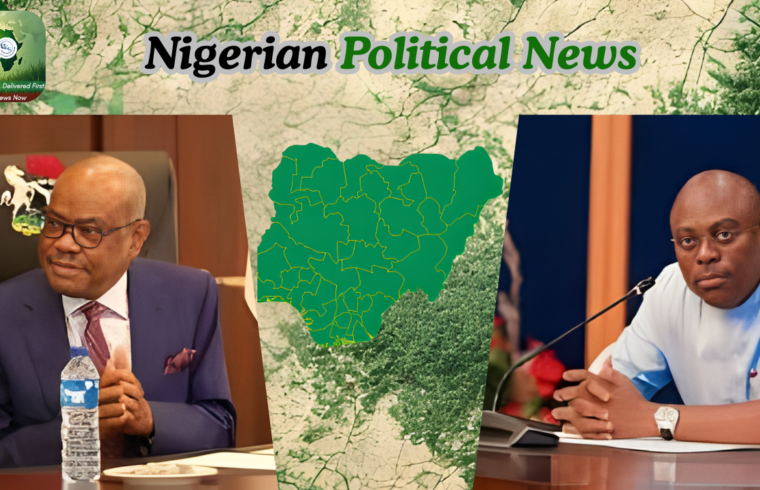
Political turbulence in Rivers State has drawn renewed criticism as an APC leader alleges that the prolonged face-off between Nyesom Wike and Governor Siminalayi Fubara is crippling governance and slowing development across the oil-rich state.
Eze Chukwuemeka Eze, a senior figure in the All Progressives Congress (APC), argued that what began as a political disagreement has evolved into a damaging power struggle. According to him, the tension has disrupted administrative continuity and created uncertainty within the state’s leadership structure.
Governance Interrupted
Eze claimed that before the declaration of emergency rule by President Bola Tinubu, Rivers had maintained a steady governance trajectory. However, he contended that subsequent developments effectively froze state operations, leaving projects and policy implementation in limbo.
Among the most visible setbacks, he noted, was the suspension of major infrastructure efforts — including the ambitious Ring Road project designed to link multiple local government areas. Delays, he warned, could significantly inflate project costs and derail timelines for other initiatives tied to economic expansion.
Economic Fallout
Beyond infrastructure, Eze alleged that the crisis has rattled investor confidence. He pointed to reported job losses, reduced internally generated revenue, and salary delays as signs of a broader economic slowdown. According to him, political instability tends to discourage both local and foreign investors from committing capital to long-term ventures.
He further accused the FCT Minister of obstructing developmental strides in Rivers, arguing that prolonged political dominance has undermined the state’s progress. Eze also referenced the dismantling of certain projects initiated under former Governor Rotimi Amaechi, particularly in agriculture, education, and security.
Control and Consequences
In his assessment, the feud stems from a struggle for influence following the 2023 governorship election. Although Wike was instrumental in Fubara’s emergence as governor, Eze suggested that efforts to retain overarching control have fueled ongoing discord.
He claimed the crisis persists because of attempts to dictate the governor’s decisions, portraying Fubara as someone expected to operate under strict political oversight. Such dynamics, he argued, have complicated governance and prolonged instability.
Commendation Amid Crisis
Despite his criticisms, Eze acknowledged what he described as Fubara’s resilience under pressure. He praised the governor’s efforts to keep administrative processes afloat amid distractions, noting that stabilizing the state will require time and strategic patience.
Broader Implications
The Rivers dispute highlights how internal political rivalries can ripple outward, affecting public services, infrastructure timelines, and economic confidence. Analysts observe that prolonged conflicts between political heavyweights often create governance bottlenecks that outlast the original disagreement.
For Rivers State, the challenge now lies in restoring political harmony while safeguarding development priorities. Whether reconciliation is possible remains uncertain, but the cost of continued confrontation may ultimately be borne by citizens.
As the situation unfolds, stakeholders across party lines are watching closely, aware that Rivers remains a critical player in Nigeria’s economic and political landscape.
© 2025 Gossip News Now , a division of CHIEJOS HARBIAN DIGITAL MEDIA LTD. Contact us via admin@gossipnewsnow.online