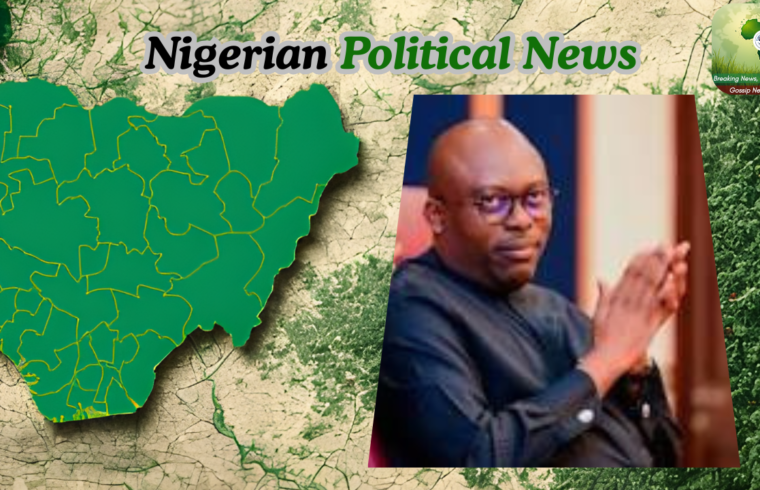
The political uncertainty surrounding Rivers State Governor Siminalayi Fubara has taken a new dimension following claims that the ongoing impeachment battle may ultimately be settled not by political negotiation but through judicial intervention.
Austin Okai, a prominent figure within the African Democratic Congress (ADC), weighed in on the crisis, arguing that the governor’s immediate political future now depends largely on court rulings rather than party protection or executive influence. His remarks come amid escalating tensions between the governor and members of the Rivers State House of Assembly.
Allegations of Political Isolation
During a media interview, Okai suggested that Governor Fubara may have been politically abandoned at a critical moment. According to him, expectations that powerful allies would intervene to halt impeachment efforts have not materialised, leaving the governor exposed to legislative pressure.
He maintained that the impeachment proceedings appear designed to weaken the governor’s authority and possibly prevent him from completing his tenure in office.
Okai expressed the view that federal political actors who were believed to be supportive failed to act decisively when the situation escalated. In his assessment, if strong backing truly existed, the crisis would likely have been resolved through internal political mechanisms rather than courtroom battles.
Judiciary Emerges as Central Battleground
Rather than relying on party negotiations, the governor has increasingly turned to legal channels. Okai noted that court protection now represents the most viable safeguard against removal from office, describing the judiciary as the final institution capable of determining the outcome.
Reframing his argument, the ADC chieftain implied that the unfolding events demonstrate how legal institutions often become the ultimate arbiters when political alliances collapse.
Questions Over Legislative Control
Another major concern raised involved the governor’s relationship with the State House of Assembly. Okai argued that the situation reveals a deeper political vulnerability, suggesting that a governor unable to command loyalty within the legislature faces significant governance challenges.
He portrayed the crisis as an example of how internal party dynamics can shift rapidly, leaving even sitting governors without reliable political support structures.
Possible Political Outcomes
While acknowledging the seriousness of the impeachment threat, Okai suggested that survival in office—even for a single term—could still be viewed as a political victory under the circumstances. His remarks implied that preserving tenure, rather than securing long-term dominance, may now be the governor’s immediate objective.
He also questioned why the ruling party had not moved more forcefully to mediate the dispute, observing that governors are traditionally regarded as the political leaders of their parties within their states.
Underlying Power Calculations
Okai concluded that broader strategic considerations may be influencing current developments. He hinted that internal political comparisons and competing interests within powerful circles could explain the perceived reluctance to intervene.
According to his analysis, political relevance and influence often determine the level of institutional support a leader receives during moments of crisis.
Commentary & Analysis
The Rivers State situation illustrates the fragile balance between executive authority, party loyalty, and legislative power in Nigerian politics. Governors typically rely on strong alliances within both party structures and state assemblies to maintain stability; once those relationships weaken, legal battles frequently replace political consensus.
Analysts observe that impeachment processes in Nigeria often extend beyond constitutional procedures, reflecting deeper struggles for influence among political heavyweights. In such scenarios, courts become decisive arenas where political conflicts are translated into legal arguments.
If judicial rulings ultimately favour the governor, it could reinforce the judiciary’s growing role as a stabilising force in political disputes. Conversely, an adverse outcome may reshape Rivers State’s political landscape ahead of future electoral cycles.
For now, observers agree on one point: the resolution of the crisis may depend less on party negotiations and more on how the courts interpret the unfolding constitutional contest.
© 2025 Gossip News Now, a division of CHIEJOS HARBIAN DIGITAL MEDIA LTD. Contact us via admin@gossipnewsnow.online