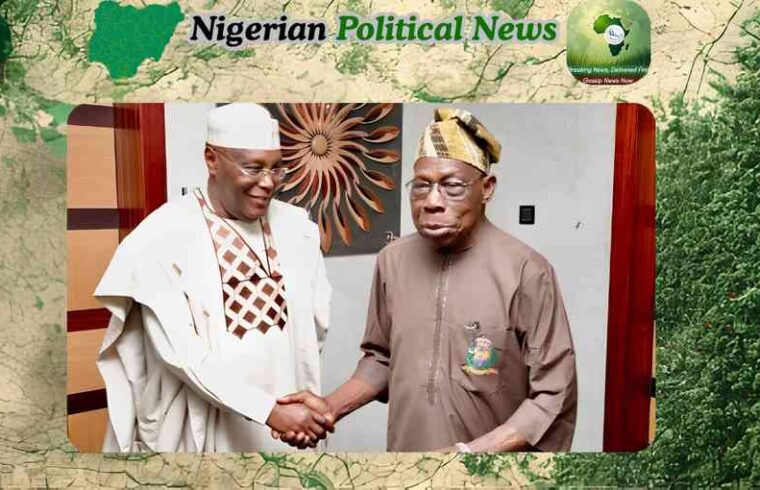
Atiku Abubakar’s Senior Political Assistant, Demola Olarewaju, has said the lingering disagreement between the former Vice President and former President Olusegun Obasanjo is rooted in political differences rather than a personal dispute.
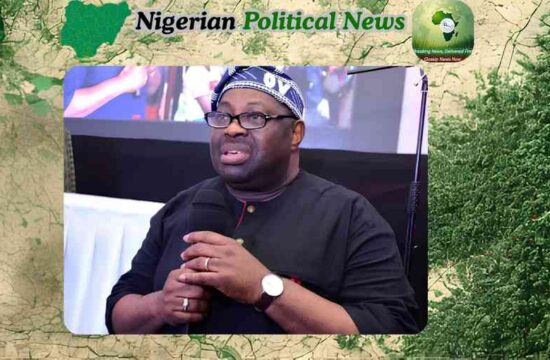
Olarewaju made the claim on Monday during an interview on Frontline, a current affairs programme on Eagle 102.5 FM, Ilese-Ijebu, Ogun State, where he appeared alongside the Executive Director of the Centre for Responsive Governance, Ayodeji Ologun.
The comments come amid renewed exchanges between the two former leaders over their political relationship and Atiku’s presidential ambitions.
What The Dispute Is About
At the centre of the disagreement are competing accounts of the relationship between Obasanjo and Atiku, who served together as President and Vice President from 1999 to 2007.
Obasanjo recently described his decision to choose Atiku as his running mate in 1999 as the “biggest mistake” of his political life.
The former President also alleged that Atiku was involved in a plot to impeach him in 2003, claiming that the former Vice President paid ₦5 million to the then Speaker of the House of Representatives, Ghali Umar Na’Abba, to commence the process.
Atiku, through his media aides, rejected the allegations, describing them as part of what he called a long-running campaign of “lies, deceit and historical distortion.”
The former Vice President also attributed Obasanjo’s resentment towards him to his refusal to support the former President’s bid for a third term in office, saying he chose the Constitution and Nigeria’s democratic interests over personal loyalty.
Stakeholder Positions
Olarewaju offered a different interpretation of the relationship, arguing that the disagreement between the two former leaders was political rather than personal.
According to him, Atiku continues to hold Obasanjo in high regard despite their political differences.
“The relationship between the former President Obasanjo and Atiku, in my view as a Nigerian who witnessed the administration and the post-administration, is the fact that they do not seem to have a personal issue. It is clear from how Atiku holds Obasanjo in high esteem,” Olarewaju said.
He, however, alleged that Obasanjo did not want Atiku to become President.
“The issue between them is political and, for reasons best known to Obasanjo, it is very clear and obvious that he does not want Atiku Abubakar to ever be President of the Federal Republic,” he said.
Ologun also argued that Obasanjo’s position on Atiku had changed considerably over the years.
He recalled that Obasanjo spoke positively about Atiku ahead of the 2019 presidential election, particularly praising his understanding of governance.
“In 2019, Obasanjo spoke well about Atiku, saying that he knows well about running the affairs of the country,” Ologun said.
Ologun further pointed to the working relationship between the two men during the Obasanjo administration, saying Atiku played an effective role as Vice President.
He questioned why Obasanjo later opposed Atiku’s presidential bid in 2023 and continued to oppose him.
The Political History Behind The Dispute
The disagreement between Obasanjo and Atiku dates back to their years in government and has continued through successive political cycles.
Olarewaju argued that Obasanjo’s political activities since leaving office in 2007 amounted to what he described as a “journey of redemption”.
He linked this, in part, to Obasanjo’s efforts to rebuild his relationship with the Yoruba people, citing the former President’s role during the Nigerian Civil War and his subsequent political interventions in the South-West.
Olarewaju also compared Obasanjo’s relationship with successive administrations, claiming that the former President was more critical of the governments of former Presidents Goodluck Jonathan and Muhammadu Buhari than he had been of President Bola Tinubu’s administration.
He further downplayed Obasanjo’s political influence in the South-West, particularly his ability to determine electoral outcomes in the region.
The claims form part of Olarewaju’s broader argument that the former President’s opposition to Atiku should be understood within the context of political differences rather than a personal disagreement.
What They Said
Olarewaju maintained that Atiku’s political camp remained committed to his presidential campaign despite Obasanjo’s opposition.
“We are determined that this opposition won’t affect Atiku’s campaign,” he said.
Ologun similarly rejected the suggestion that Atiku had personally wronged Obasanjo.
“But no matter what happens, we want Nigerians to understand the truth that Atiku never did a thing to Obasanjo. Obasanjo is attacking Atiku for political reasons; he doesn’t want him to become the president,” Ologun said.
Olarewaju also questioned what he described as Obasanjo’s belief that no other leader could match his achievements or govern Nigeria better than he did.
“I think another thing that has become very clear is his instability about the opinion that Obasanjo holds that nobody can meet up with his achievement and nobody can govern Nigeria better than him,” he said.
What The Dispute Reveals
The latest comments show that the disagreement between Obasanjo and Atiku continues to be interpreted differently by the two sides and their supporters.
Obasanjo’s recent criticism of his former vice president has revived questions about the political relationship that developed during their years in government, while Atiku’s camp has continued to reject the former President’s account of the relationship.
Olarewaju’s position is that the dispute is fundamentally political and connected to Atiku’s presidential ambitions. Ologun, meanwhile, points to Obasanjo’s earlier positive comments about Atiku as evidence that the former President’s position has changed over time.
The supplied accounts, however, do not independently establish Obasanjo’s motives for opposing Atiku.
Political Implications
The disagreement remains politically significant because Atiku continues to pursue his presidential ambitions, while Obasanjo remains a prominent figure whose views on national politics attract public attention.
Olarewaju said Atiku’s supporters were determined not to allow Obasanjo’s opposition to affect the former Vice President’s campaign.
At the same time, the competing accounts ensure that the history between the two former leaders remains part of the wider political discussion surrounding Atiku’s ambitions.
Whether the disagreement has a broader effect on Atiku’s political prospects cannot be established from the statements contained in the interview.
Final Editorial Wrap-Up
The latest exchange has once again brought the long-running political relationship between Obasanjo and Atiku into focus.
While Obasanjo has previously criticised his decision to choose Atiku as his running mate and made allegations concerning their relationship, Atiku has rejected those claims and offered a different explanation for their political fallout.
Olarewaju has now reinforced that alternative account, arguing that the disagreement is political rather than personal and alleging that Obasanjo does not want Atiku to become President.
Ologun has similarly pointed to Obasanjo’s earlier positive assessment of Atiku as evidence of a significant change in the former President’s position.
For now, the competing accounts leave the political disagreement unresolved, with both sides continuing to interpret the history of the Obasanjo-Atiku relationship differently.