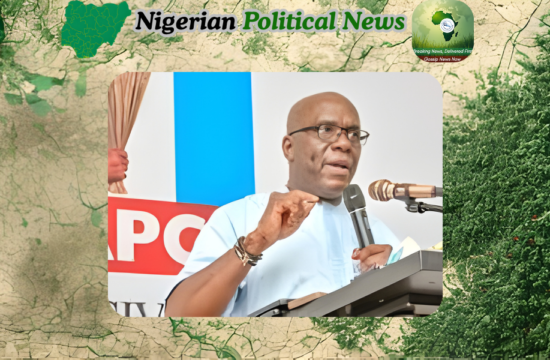


Human rights advocate and public affairs commentator Mahdi Shehu has warned that the ruling All Progressives Congress may eventually experience a political decline similar to that of the Peoples Democratic Party if it continues, in his view, to act with excessive confidence and disregard for public accountability.
In a statement shared on his verified X account on Monday, October 27, Shehu argued that the APC is beginning to mirror the same troubling patterns that once defined the PDP during its long years in power. He suggested that the warning signs are already visible in what he described as growing intolerance, institutional damage, and a widening gap between the government and ordinary citizens.
According to Gossip News Now, Shehu drew a direct comparison with a famous declaration made in 2008 by former PDP National Chairman Vincent Ogbulafor, who had boldly claimed the party would remain in power for 60 years. Shehu used that moment to illustrate how political dominance can quickly unravel, insisting that the PDP’s eventual loss of power proved that no party is politically untouchable.
He went further by portraying the opposition party as an organisation now struggling for relevance, using sharp language to suggest that the PDP has fallen into such deep crisis that even its political survival appears uncertain. That observation formed the foundation of his broader message that arrogance in power often carries the seeds of eventual downfall.
Turning his attention to the APC, Shehu said the ruling party appears to be moving in the same dangerous direction. He accused it of pressuring critics, weakening institutions, targeting opponents, and contributing to national division at a time when many Nigerians are already worried about economic hardship and political tension.
In his assessment, such conduct could hasten the party’s decline if it fails to change course. He warned that any government that leans too heavily on power while ignoring justice, restraint, and public trust may not remain secure for long, no matter how strong it appears in the present.
To reinforce his position, Shehu referenced several biblical passages and framed his criticism in moral as well as political terms. By invoking scripture, he argued that leaders who abuse authority and govern with pride should not assume they can escape consequences forever.
His concluding remarks were especially forceful, as he suggested that the APC, like the PDP before it, may be heading toward a moment of reckoning. In essence, his message was that political power is temporary, and parties that fail to learn from history often end up repeating it.
Commentary and Analysis
Mahdi Shehu’s statement is significant because it taps into a recurring theme in Nigerian politics: the belief that ruling parties often become most vulnerable when they begin to act as though power is permanent. His comparison between the APC and the PDP is designed not just as criticism, but as a warning rooted in political history.
The remarks also reflect a broader public frustration with how institutions are perceived to function under pressure. When commentators begin to frame governance issues in moral and even spiritual language, it often signals deeper anxiety about accountability, leadership, and the direction of the country.
Whether or not one agrees with Shehu’s position, his intervention adds to the growing debate over how power is being exercised in Nigeria. It also reminds political actors that public confidence can erode gradually, and once that process begins, recovery is rarely easy.
© 2025 Gossip News Now, a division of CHIEJOS HARBIAN DIGITAL MEDIA LTD. Contact us via admin@gossipnewsnow.online