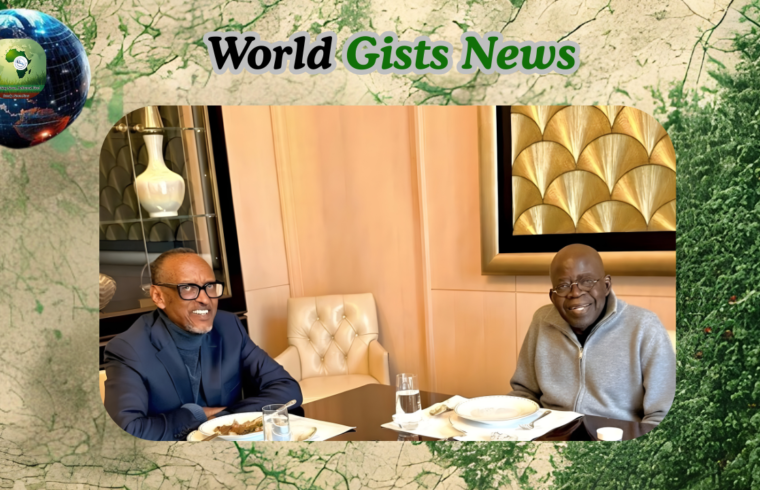
Nigeria’s Presidency has reacted strongly to online speculation surrounding a photograph showing President Bola Ahmed Tinubu alongside Rwandan President Paul Kagame, insisting that the image was authentic and not artificially generated.
The controversy emerged after the photograph, reportedly taken during diplomatic engagements in Paris, circulated widely across social media platforms, prompting debates over whether artificial intelligence technology had been used to create the scene.
Questions intensified after some internet users pointed to visible links associated with Grok, the artificial intelligence chatbot developed by xAI, leading to claims that the image may have been digitally fabricated rather than captured during a real meeting.
The discussions gained momentum shortly after presidential aide Bayo Onanuga, Special Adviser on Information and Strategy, shared updates regarding President Tinubu’s international engagements.
According to Gossip News Now, the Presidency later moved to counter the growing speculation, describing the claims as misleading and inaccurate.
Responding to the controversy, presidential media aide Temitope Ajayi clarified that the photograph genuinely captured a real-life interaction between Tinubu and Kagame.
Ajayi explained that although the image underwent enhancement to improve picture quality, no artificial intelligence system was used to create or manipulate the actual event shown in the photograph.
He further stated that the meeting between the Nigerian and Rwandan leaders involved a lunch engagement before both presidents later attended a separate dinner hosted by French President Emmanuel Macron.
The presidential aide disclosed that the original image was taken with a mobile phone device, resulting in lower image quality that later required refinement for clearer public presentation.
Ajayi also cautioned against assuming that all enhanced photographs automatically qualify as AI-generated content, stressing that image improvement tools are commonly used in media production without altering the authenticity of events captured.
The Presidency maintained that the picture accurately reflected genuine diplomatic interactions and urged the public to avoid spreading unverified claims capable of creating unnecessary misinformation online.
The incident has once again sparked wider conversations about the growing influence of artificial intelligence technology and the difficulty many social media users face in distinguishing between edited content and fabricated visuals.
Media Commentary and Analysis
The controversy surrounding the Tinubu-Kagame photograph reflects the increasing skepticism that now surrounds digital images in the age of artificial intelligence.
Analysts believe the rapid growth of AI-generated content has made the public more cautious about photographs and videos shared online, especially when they involve political figures or sensitive diplomatic events.
Observers also note that governments and public institutions may increasingly face pressure to provide clearer verification and transparency regarding official media materials as AI technology becomes more advanced.
As digital tools continue evolving, experts say public understanding of the difference between image enhancement and outright artificial image generation will become even more important in combating misinformation.
© 2025 Gossip News Now , a division of CHIEJOS HARBIAN DIGITAL MEDIA LTD. Contact us via admin@gossipnewsnow.online