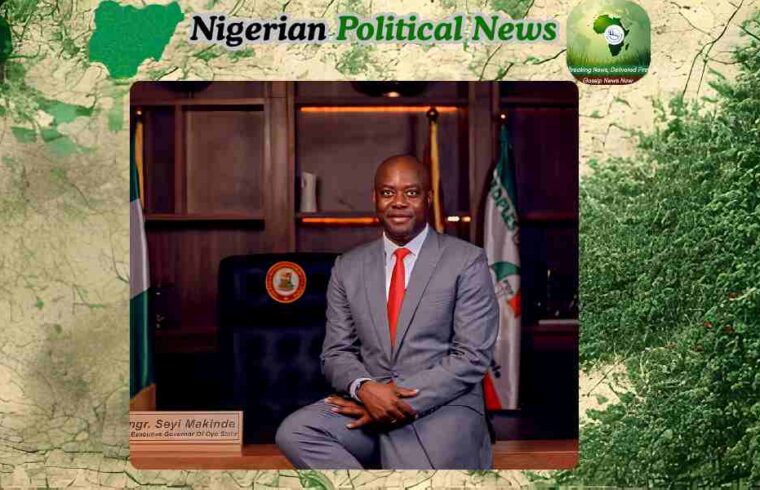
Former Oyo State Commissioner for Justice, Adebayo Mutalubi Ojo, has warned that Governor Seyi Makinde could lose the support of some politicians currently aligned with him before the 2027 elections.
Ojo said political calculations within the governor’s camp could change significantly as the election approaches, arguing that some of those publicly supporting Makinde may eventually oppose the candidate he backs to succeed him.
He made the remarks during an appearance on OpenForum360, a political podcast in Ibadan.
Ojo’s Warning About Makinde’s Political Camp
According to Ojo, the political support surrounding Makinde may not remain intact as the 2027 election approaches.
He said some politicians currently associated with the governor could eventually distance themselves from him and oppose his preferred candidate.
Ojo did not identify the politicians he was referring to, saying he knew who they were but could not mention their names.
“I can’t be mentioning names. I know them. I know you know what is happening. They are deceiving him.”
He added that political calculations often involve competing interests and described politics as an enterprise driven by intrigues rather than straightforward loyalty.
Ojo’s comments represent his assessment of the situation, and the claims about unnamed politicians preparing to leave Makinde were not independently established in the material provided.
December 2026: The Point Ojo Expects to Matter
Ojo specifically pointed to December 2026 as a period when he believes the political situation around Makinde could become clearer.
He predicted that many of the politicians he currently sees as being around the governor could leave his camp and openly oppose his preferred candidate.
“Believe me, by December, you will see what will happen. Most of them will leave him. And they will come out to oppose his candidate.”
The significance of the prediction is that Ojo is not describing an immediate collapse of Makinde’s political support. Instead, he is suggesting that the governor’s current coalition could be tested as the succession contest and wider 2027 calculations become more defined.
The Makinde–Adekanmbi Succession Question
A major part of Ojo’s argument concerns Bimbo Adekanmbi, whom the source identifies as Makinde’s preferred successor in Oyo State.
Ojo argued that Adekanmbi would inherit both the political goodwill associated with Makinde and the opposition that has developed against the governor.
He described the two political positions as being closely connected, comparing Makinde and Adekanmbi to “Siamese twins.”
Ojo also described Adekanmbi as his “good brother” and “friend”, but warned that people around the prospective successor could prevent him from seeing some of the political realities developing around him.
The source also states that Makinde is being presented as the 2027 presidential candidate of the APM. That claim is retained here as part of the source material rather than presented as an independently verified fact.
Why Makinde’s Popularity Could Become a Political Issue
Ojo identified Makinde’s popularity as one of the governor’s strongest political assets.
However, he argued that the same political strength could become a disadvantage if the governor’s popularity leads those around him to shield him from information about dissatisfaction within his political camp.
That argument forms an important part of Ojo’s warning: the issue, in his view, is not simply whether Makinde remains personally popular, but whether that popularity translates into continued political support for the candidate he wants to succeed him.
The distinction could become important as politicians assess their own interests ahead of the 2027 elections.
The PDP Factor
Ojo also contrasted the situation in Oyo with developments within the Peoples Democratic Party, particularly the question of how freely party members can participate in the selection of candidates.
He suggested that the situation could be different if the PDP conducted transparent, free and fair primaries.
His argument is that an open primary process could alter the calculations of politicians who may otherwise publicly support an established political structure while maintaining private reservations.
Ojo further referred to political figures including Lanlehin, Adebayo Adelabu, Senator Buhari, Bayo Titilola-Sodo, Babs Oduyoye and Fatai Owoseni while discussing political reconciliation and competing interests within the state’s political environment.
What Ojo’s Comparison With APC Suggests
In making his comparison, Ojo referred to the reconciliation efforts associated with Lanlehin and the positions of several APC figures.
He also cited the experience of politicians in Osun State who, according to his account, remained publicly aligned with the APC despite reservations before the party later suffered electoral setbacks.
Ojo’s broader point was that political loyalty can sometimes remain publicly intact until circumstances change enough for politicians to act differently.
That assessment is part of his political analysis and does not establish that the same sequence will occur in Oyo State.
The Political Implication for 2027
The central question raised by Ojo’s warning is whether Makinde can transfer his political influence into sustained support for his preferred successor.
A governor may retain significant personal popularity while still facing difficulties maintaining a political coalition around a successor. The two are related, but they are not necessarily the same.
If Ojo’s prediction proves accurate, the pressure could become more visible as the 2027 succession contest develops and politicians begin making clearer calculations about their future positions.
But if Makinde succeeds in maintaining the coalition currently surrounding him, the governor’s political influence could remain an important factor in determining the direction of the succession contest.
A Political Contest Still in Motion
For now, Ojo’s warning remains a political prediction rather than an established development.
His central argument is that the apparent strength of Makinde’s current political support should not necessarily be taken as permanent, particularly as the 2027 election approaches and the succession question becomes more competitive.
The December 2026 period he identified therefore serves as a specific point against which his prediction can eventually be assessed.
For Makinde, the broader political challenge is not only maintaining his own support but also ensuring that the political network around him remains sufficiently cohesive to support the succession arrangement he favours.