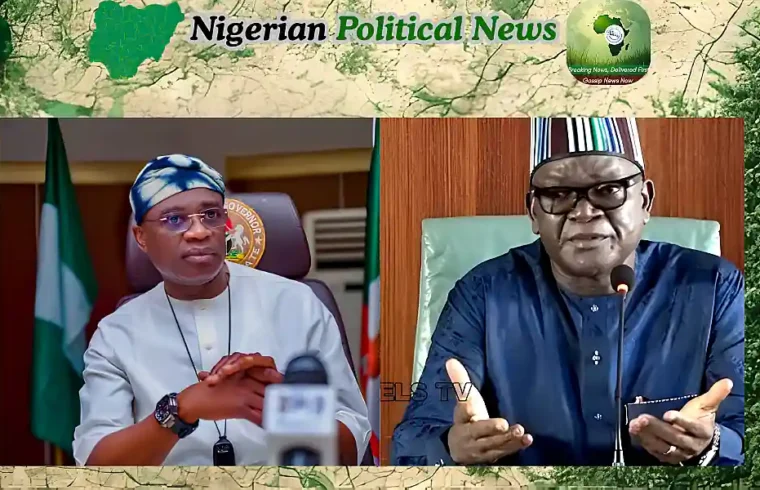
Former Benue State Governor Samuel Ortom has challenged Governor Hyacinth Alia to explain how the state government and its 23 local government areas have utilised what his camp described as about ₦1.2 trillion received from the Federation Account Allocation Committee (FAAC) since 2023.
The challenge has opened another political dispute between the former and incumbent administrations, with Ortom’s camp focusing on accountability and public spending, while Alia’s administration has defended its record and questioned the suggestion that increased federal revenue translates into unlimited resources for the state.
Key Facts
- Samuel Ortom is questioning how FAAC-related revenue received since 2023 has been utilised.
- Ortom’s camp put the combined figure for the state government and the 23 local government areas at about ₦1.2 trillion.
- The former governor’s concerns were presented by his media consultant and former media and publicity adviser, Terver Akase, during a news conference in Makurdi.
- Hyacinth Alia’s administration has rejected the criticism and defended its record.
- Alia’s Chief Press Secretary, Sir Tersoo Kula, argued that increased federal revenue does not automatically give state governments unlimited resources.
What Happened?
The dispute followed comments from former Governor Samuel Ortom, who called on Governor Hyacinth Alia’s administration to account for the funds Benue has received from FAAC since the current administration took office in 2023.
Ortom’s media consultant, Terver Akase, presented the former governor’s position during a news conference in Makurdi.
According to Akase, the Alia administration and the state’s 23 local government areas have received about ₦1.2 trillion from FAAC from 2023 to date.
He questioned what projects had been executed with the resources and why, in his view, local government areas across the state remained without sufficient visible government presence despite the alleged increase in revenue.
Akase also criticised the governor’s media aides for focusing on attacks against Ortom and former Attorney-General of the Federation and Minister of Justice, Michael Aondoakaa, rather than addressing what he described as the administration’s accountability questions.
The former governor’s camp therefore wants the government to provide greater clarity on the revenue it has received and how those resources have been deployed.
Stakeholder Positions
The dispute has produced two opposing positions.
Ortom’s camp is focusing on financial accountability. Its argument is that the increased revenue available to the state and local governments since the removal of the fuel subsidy should be matched by clear information about projects, spending and public-sector delivery.
The former governor’s representatives have particularly questioned the level of visible development across the state’s local government areas in relation to the revenue they say has been received.
Alia’s camp, however, has rejected the implication that the revenue figure alone demonstrates that the administration had unlimited funds at its disposal.
Through his Chief Press Secretary, Sir Tersoo Kula, the governor’s camp argued that increased federal revenue must be considered alongside the broader financial obligations and realities facing state governments.
Kula also brought the previous Ortom administration into the debate, arguing that Benue had previously cited limited resources as a reason for underperformance.
Alia’s Camp Responds
Responding to the criticism, Sir Tersoo Kula, the Chief Press Secretary to Governor Hyacinth Alia, said the administration’s record was strong enough to merit recognition, particularly when compared with that of the previous government led by Ortom.
Kula argued that increased federal revenue should not automatically be interpreted as meaning that state governments have unlimited financial resources.
He also recalled that during Ortom’s administration, Benue was among states that frequently cited a lack of funds as an explanation for what Kula described as underperformance.
The response therefore shifted the political debate from the amount of revenue received by the current administration to the broader question of how government performance should be assessed in the context of available resources and competing financial demands.
Background
The dispute comes against the backdrop of changes in Nigeria’s federal revenue environment following the removal of the fuel subsidy.
For Benue, the issue has become politically significant because both the state government and its 23 local government areas are being discussed in relation to the revenue allocations said to have been received since 2023.
Ortom’s camp is using the reported increase in revenue to demand greater accountability from the current administration.
Alia’s camp, meanwhile, is challenging the assumption that higher allocations automatically translate into unrestricted funds available for government projects.
The disagreement has consequently placed public spending and government performance at the centre of the political exchange between the two administrations.
Accountability Watch
At the centre of the dispute is a straightforward governance question: how should revenue received by government be accounted for and connected to measurable public outcomes?
Ortom’s camp has asked what projects have been executed with the resources it says were received from FAAC and why it believes government presence remains limited in parts of the state.
Those questions, however, should be distinguished from any conclusion that the funds were improperly used. The material available does not establish such a finding.
For the current administration, the response has been that revenue increases do not by themselves provide a complete picture of the resources available to government.
The accountability issue therefore remains focused on transparency over revenue receipts, expenditure and project delivery. A comprehensive assessment would require detailed financial records, expenditure information and independently verifiable evidence concerning the projects and programmes financed during the period.
Governance Perspective
The disagreement goes beyond the political exchange between two former and current administrations because it touches on how citizens assess government performance.
Revenue allocations are only one part of the governance equation. The more important public-interest question is how available resources are translated into infrastructure, services, programmes and other measurable outcomes.
For Benue residents, transparency over government revenue and expenditure can help provide a clearer basis for assessing whether public resources are producing the expected results.
At the same time, claims about revenue levels and government performance need to be supported by verifiable financial and project information before firm conclusions can be drawn.
The current dispute therefore places attention on both sides of the accountability equation: the government’s responsibility to explain how public resources are used and the need for political claims about those resources to be supported by evidence.
Political Significance
The exchange between Samuel Ortom and Hyacinth Alia illustrates how questions about government finances can become part of a wider political contest over administrative performance.
Ortom’s camp is using the reported FAAC inflows to question the current administration’s accountability and delivery, while Alia’s camp is defending the government’s record and drawing comparisons with the previous administration.
The immediate dispute may therefore continue to centre on competing assessments of revenue, expenditure and visible development across Benue.
More broadly, the issue highlights the political importance of financial transparency and measurable government performance, particularly when administrations change and their records are compared.
Final Editorial Wrap-Up
The controversy over Benue’s FAAC revenue has placed public spending, accountability and government performance at the centre of another political exchange between the Ortom and Alia camps.
Ortom’s representatives have challenged the current administration to explain how the funds they estimate at about ₦1.2 trillion were utilised by the state government and the 23 local government areas since 2023.
Alia’s camp has responded that increased federal revenue does not automatically mean unlimited resources, while also defending the administration’s record against comparisons with the previous government.
For now, the key issue remains the demand for clarity over revenue received, expenditure and measurable government outcomes. Any definitive assessment of how the funds were utilised would require detailed financial and project records beyond the claims contained in the political exchange.