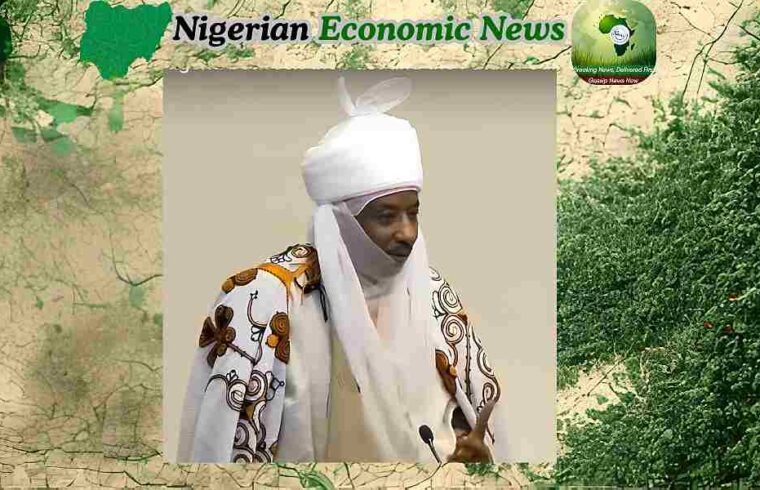
The Emir of Kano, Muhammadu Sanusi II, has criticised the communication approach of President Bola Tinubu’s administration, accusing the government of treating suggestions and contributions it disagrees with as attacks.
However, the former Governor of the Central Bank of Nigeria (CBN) has acknowledged the progress made through the administration’s economic reforms, saying the government deserves recognition for helping to pull the country back from the brink.
Sanusi made the remarks at the Oxford Global Think Tank conference convened by Arunma Oteh, where he discussed Nigeria’s economic performance, government communication and the progress recorded under the current administration.
His assessment presented a mixed picture of the country’s economic situation, recognising improvements in key indicators while highlighting weaknesses that could affect public confidence and the sustainability of the recovery.
Key Takeaways
- Emir Muhammadu Sanusi II criticised the Tinubu administration for allegedly treating unwelcome suggestions and contributions as attacks.
- He said the government lacked effective spokespersons to communicate its policies and explain its decisions.
- Sanusi acknowledged improvements in Nigeria’s economic performance and commended the administration’s reforms.
- He cited GDP growth of 4.48 per cent in the second quarter of 2026.
- He said inflation had declined from 30 per cent to 14.6 per cent, with a projection of 12.5 per cent by the end of the year.
- He stated that GDP per capita in dollar terms had increased by 47 per cent since 2023.
- Nigeria’s external reserves stood at $55 billion, although he warned that much of the figure was driven by volatile portfolio inflows.
- He identified the Dangote Refinery’s contribution to exports as evidence of progress in economic diversification.
Sanusi Criticises Tinubu Government Over Communication
One of Sanusi’s major concerns was the way the Tinubu administration responds to criticism, suggestions and contributions from individuals who disagree with its approach.
The Emir argued that the government had not communicated its policies effectively and appeared to interpret alternative opinions as attacks rather than opportunities for constructive engagement.
He also questioned the administration’s communication structure, saying it lacked good spokespersons capable of explaining government decisions and responding effectively to public concerns.
Speaking at the Oxford Global Think Tank conference, Sanusi said:
“This government doesn’t express itself properly. It sees every suggestion and contribution it does not like as an attack, and it doesn’t have good spokespersons,”
His criticism focused on the administration’s handling of public communication, rather than an outright rejection of its economic policies.
Indeed, despite expressing dissatisfaction with the government’s communication approach, Sanusi went on to acknowledge improvements in the country’s economic indicators.
Sanusi Acknowledges Improvements in Nigeria’s GDP Growth
Despite his criticism, the former CBN governor commended the Tinubu administration for its economic reforms, pointing to improvements in Nigeria’s gross domestic product (GDP) growth.
Sanusi cited GDP growth of 4.48 per cent in the second quarter of 2026, describing the performance as progress compared with the weaker growth recorded during the previous administration.
He compared the current growth performance with the economic figures under the administrations of former Presidents Umaru Musa Yar’Adua, Goodluck Jonathan and Muhammadu Buhari.
According to Sanusi, Nigeria’s economy grew by just 0.9 per cent during the Buhari years, while the current growth rate had improved to approximately 4.5 per cent.
Explaining his assessment, he said:
“It’s not as high as it was under the Yar’Adua/Jonathan government, but during the Buhari years, the economy grew by 0.9%. Today it is at 4.5%. That’s progress. Inflation is down from 30% to 14.6% and is projected to be 12.5% by the end of the year. That is progress,”
His comparison placed the current economic performance within a wider historical context, while highlighting the improvement he believes has followed the government’s reform programme.
Inflation Falls as Sanusi Highlights Economic Progress
Sanusi also pointed to the decline in Nigeria’s inflation rate as another indication that the administration’s economic reforms were beginning to produce results.
He stated that inflation had dropped from 30 per cent to 14.6 per cent, with a further decline to 12.5 per cent projected by the end of the year.
The distinction between the current figure and the projected rate is important. The 14.6 per cent figure represents the rate cited by Sanusi, while 12.5 per cent remains an expected outcome rather than a confirmed result.
The former CBN governor’s assessment suggests that he sees the reduction in inflation as an encouraging development, although the broader economic recovery remains a work in progress.
Nigeria’s GDP Per Capita Rises by 47 Per Cent Since 2023
Beyond GDP growth and inflation, Sanusi highlighted the improvement in Nigeria’s GDP per capita measured in dollar terms.
He said the figure had increased by 47 per cent since 2023 and could return to its 2005 level by the end of the following year if the current trend continued.
GDP per capita measures the value of economic output relative to the population. It is commonly used to assess average economic output per person, although it does not necessarily show how income is distributed among citizens.
Sanusi’s observation therefore adds another dimension to his assessment of the country’s recovery, particularly in relation to the improvement in Nigeria’s economic position since 2023.
However, his expectation that GDP per capita could return to its 2005 level remains conditional on the continuation of the current trend.
Nigeria’s $55 Billion External Reserves and Foreign Investment
Sanusi also discussed Nigeria’s external reserves, stating that they stood at approximately $55 billion.
However, he cautioned that a significant portion of the reserves was being supported by volatile portfolio inflows.
Portfolio investments can provide foreign exchange and strengthen a country’s external position, but they may also be sensitive to changing market conditions, investor confidence and international financial developments.
The former CBN governor explained that high oil prices, partly resulting from the conflict in the Strait of Hormuz, had helped attract investment into Nigeria.
He also identified attractive returns as another factor encouraging investors to maintain their interest in the Nigerian market.
His observation highlights an important qualification in the country’s economic recovery: although stronger external reserves can improve confidence in the economy, the sources of those reserves also matter when assessing their sustainability.
Dangote Refinery’s Contribution to Nigeria’s Economic Diversification
Another development highlighted by Sanusi was the role of the Dangote Refinery in Nigeria’s export performance.
He said the refinery now accounted for 20 per cent of the country’s exports, describing the development as evidence that the economy was beginning to diversify.
The refinery’s contribution featured prominently in his assessment because it represents a major development in Nigeria’s domestic refining and industrial production capacity.
For an economy that has historically depended heavily on crude oil exports, increased contributions from domestic refining and other industrial activities could support broader economic diversification.
Sanusi’s remarks suggest that he considers the refinery’s growing contribution to exports one of the developments supporting the foundations for a more stable economy.
Sanusi Says Nigeria Is Laying Foundations for Economic Stability
While acknowledging improvements in several economic indicators, Sanusi maintained that Nigeria had not yet reached the end of its economic recovery journey.
He described the progress as an initial step towards stability, suggesting that the reforms and developments recorded so far should be viewed as foundations rather than a final achievement.
He stated:
“There are clearly foundations being laid for stability. It’s not the end, but the first step towards stability,”
The statement reflects his position that although the economy has recorded improvements, further efforts will be required to establish lasting stability.
His assessment also reinforces the importance of sustaining the gains recorded in GDP growth, inflation, foreign investment and export diversification.
Sanusi Says Tinubu Administration Deserves Credit Despite Political Differences
Sanusi concluded his assessment by acknowledging the efforts of the Tinubu administration, despite his reservations about politicians and the government’s communication approach.
He said that although he was not particularly fond of politicians, the administration deserved recognition for the economic progress it had achieved.
The Emir added:
“I’m not a fan of politicians, but we need to give credit to President Tinubu’s administration for bringing us back from the brink,”
His remarks underline the distinction between his criticism of the administration’s communication and his assessment of its economic policies.
Rather than dismissing the government’s performance entirely, Sanusi acknowledged that the reforms had contributed to improvements that deserved recognition.
What Sanusi’s Assessment Means for Nigeria’s Economic Outlook
Sanusi’s comments present a balanced assessment of Nigeria’s economic situation under President Tinubu.
On one hand, he identified improvements in GDP growth, inflation, GDP per capita, external reserves and export diversification as encouraging developments.
On the other hand, his concerns about volatile portfolio inflows and the government’s communication approach show that he does not consider the recovery complete.
The sustainability of the progress will depend on whether the improvements can be maintained and translated into broader economic stability.
His assessment also raises the importance of effective government communication, particularly when explaining difficult economic reforms and responding to public concerns.
Ultimately, Sanusi believes the Tinubu administration deserves credit for the progress recorded so far, but his remarks make clear that the country still has work to do before achieving lasting economic stability.
Frequently Asked Questions (FAQs)
1. What did Emir Sanusi say about Tinubu’s administration?
Emir Muhammadu Sanusi II criticised the administration for allegedly treating suggestions and contributions it dislikes as attacks. However, he also commended its economic reforms and acknowledged improvements in Nigeria’s economic performance.
2. Where did Sanusi make the remarks?
He made the comments at the Oxford Global Think Tank conference convened by Arunma Oteh.
3. What was Nigeria’s GDP growth in the second quarter of 2026, according to the article?
The article reports a GDP growth figure of 4.48 per cent for the second quarter of 2026. Sanusi referred to the figure as approximately 4.5 per cent in his remarks.
4. What did Sanusi say about Nigeria’s inflation rate?
He said inflation had declined from 30 per cent to 14.6 per cent and was projected to fall to 12.5 per cent by the end of the year.
5. How much has Nigeria’s GDP per capita increased since 2023?
According to Sanusi, GDP per capita in dollar terms had increased by 47 per cent since 2023.
6. What did Sanusi say about Nigeria’s external reserves?
He stated that Nigeria’s external reserves stood at approximately $55 billion but cautioned that much of the figure was driven by volatile portfolio inflows.
7. What role did the Dangote Refinery play in Sanusi’s assessment?
Sanusi said the Dangote Refinery accounted for 20 per cent of Nigeria’s exports, highlighting its contribution to the country’s economic diversification.
8. Does Sanusi believe Nigeria has achieved full economic stability?
No. He described the progress as the first step towards stability, indicating that more work remains before lasting economic stability can be achieved.
9. Did Sanusi praise President Tinubu’s economic reforms?
Yes. Despite his criticism of the administration’s communication approach, he said the government deserved credit for helping to bring Nigeria back from the brink.
Follow Gossip News Now for more updates on Nigeria’s economy, government policies, financial developments and breaking economic news.
© 2025 Gossip News Now, a division of CHIEJOS HARBIAN DIGITAL MEDIA LTD.