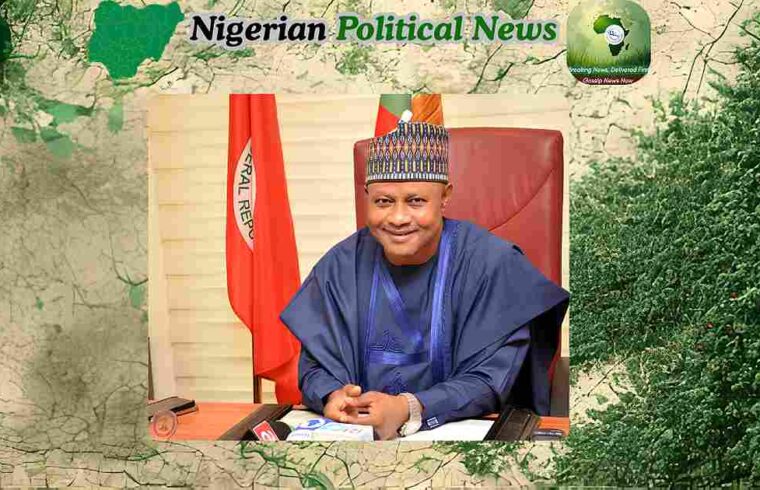
Kaduna State Governor Uba Sani has signalled that the All Progressives Congress (APC) intends to approach the 2027 presidential contest through party organisation, changing political alignments and sustained engagement with voters, rather than relying solely on the influence of individual political figures.
Sani’s comments come as attention increasingly turns to the electoral calculations surrounding President Bola Tinubu in northern Nigeria, particularly Kaduna State, where the outcome of the 2023 presidential election reflected strong opposition support.
In Brief
Speaking during an interview with Channels Television, Sani said he was focused on strengthening the APC ahead of 2027 and declined to speculate on the influence of former Kaduna governors Nasir El-Rufai, Ahmed Makarfi and Namadi Sambo.
The governor also rejected the suggestion that northern voters were turning against Tinubu, predicting that the President could obtain between 70 and 80 per cent of votes in Kaduna State in 2027.
What Happened?
Sani argued that political conditions in Kaduna have changed since the 2023 presidential election and that the factors that shaped the previous result should not automatically be expected to determine the next election.
He pointed specifically to the movement of politicians who previously belonged to opposition parties into the APC, particularly in Southern Kaduna, as part of the political changes that could influence voting patterns in 2027.
The governor also stressed the importance of grassroots campaigning, arguing that presidential political contests cannot be won through activities concentrated in Abuja.
According to him, serious engagement must extend to the wards and communities where voters are located.
Key Players
The immediate focus of Sani’s remarks was the APC and its prospects ahead of the 2027 presidential election.
President Bola Tinubu is central to the governor’s assessment, with Sani arguing that the President’s electoral support in Kaduna could increase substantially from the level recorded in 2023.
Former Kaduna governors Nasir El-Rufai and Ahmed Makarfi, as well as former Vice-President Namadi Sambo, were also referenced during the interview. Sani, however, declined to make their political influence the focus of his comments.
Former Vice-President Atiku Abubakar also remains relevant to the electoral context because he defeated Tinubu in Kaduna State during the 2023 presidential election.
Background
The significance of Sani’s prediction is partly linked to Kaduna’s voting pattern in the 2023 presidential election.
Atiku defeated Tinubu in the state during that election, making Kaduna one of the northern states where the APC presidential candidate did not secure victory.
Sani’s argument is that the political landscape has since shifted. He pointed to changes in party alignments and the movement of opposition politicians into the APC as factors that could produce a different electoral outcome in 2027.
His position therefore rests on the assumption that the political configuration that existed during the last presidential election cannot simply be carried forward into the next one.
Key Quotes
Explaining his position, Sani said he was not interested in discussing individual political personalities and instead wanted to concentrate on the APC.
“I am here to fight for APC and I’m telling you what’s going to happen.”
On Tinubu’s expected performance, the governor predicted a substantial increase in the President’s share of the vote.
“President Bola Ahmed Tinubu will move from 29 percent of votes to 70 to 80 percent.”
Sani also maintained that his assessment was based on political realities rather than sentiment, while expressing respect for the former governors whose names were raised during the interview.
Current Situation
Sani’s comments place party organisation and political realignment at the centre of his assessment of the 2027 contest in Kaduna.
His reference to politicians moving from opposition parties into the APC suggests that he sees changes in party structures and political alliances as potentially important to the next presidential election.
The governor also placed particular emphasis on grassroots engagement, arguing that political campaigns must reach voters across the country’s wards rather than remain concentrated in Abuja.
“You don’t contest with the President by campaigning in Abuja,” he said.
That position presents grassroots mobilisation as an important part of the political strategy he believes the APC needs to pursue ahead of the election.
Strategic Assessment
Sani’s remarks point to three broad elements of the APC’s electoral calculation in Kaduna.
First, he is arguing that the state’s 2023 voting pattern should not be treated as a fixed indicator of what will happen in 2027. His emphasis on political realignment suggests that changes in party membership and local political structures could affect the balance of support.
Second, his prediction of 70 to 80 per cent support for Tinubu represents a significant shift from the level he referenced from the previous presidential election. That projection is Sani’s political assessment, rather than an established electoral outcome.
Third, the governor’s emphasis on wards and grassroots engagement highlights the organisational side of presidential politics. His argument is that political competition requires sustained contact with voters at the local level and cannot depend exclusively on campaigns conducted from the nation’s political centre.
Taken together, these points show that Sani is presenting the 2027 contest as one in which changing alliances, party organisation and voter engagement could alter the political calculations that shaped Kaduna in 2023.
Election Outlook
With the 2027 presidential election still ahead, Sani’s comments add to the growing political debate over whether the voting patterns recorded in northern states in 2023 will remain intact.
For Kaduna, the key questions will include whether recent political realignments translate into measurable changes in voter support, whether the APC can effectively convert its organisational strength into grassroots support, and whether Tinubu’s performance can approach the level projected by the governor.
Sani’s comments make clear that the APC’s strategy, at least from his perspective, will involve more than relying on established political personalities. His emphasis is on party loyalty, changing political alignments and direct engagement with voters as the 2027 contest gradually takes shape.