Why It Matters
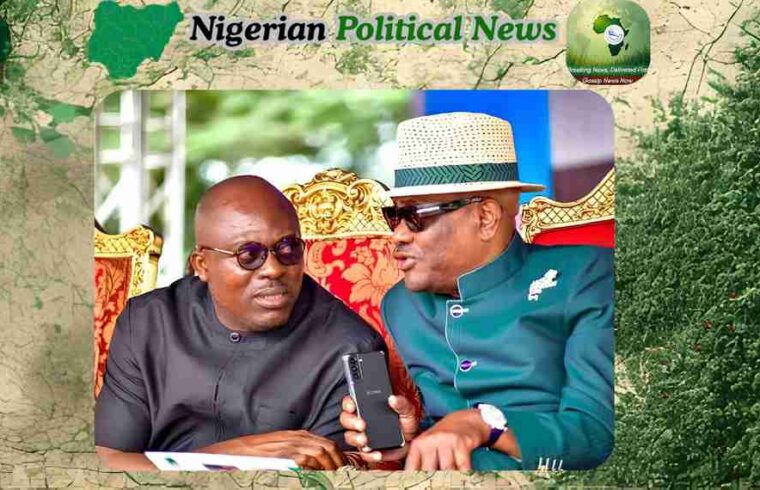
After months of political confrontation that reshaped Rivers State’s political landscape, Federal Capital Territory (FCT) Minister Nyesom Wike says the period of hostility has ended. His public declaration of reconciliation with Governor Siminalayi Fubara signals what could become a significant turning point for governance, political stability and development in the state if the peace process is sustained.
Wike Announces a New Direction
The political conversation in Rivers State shifted on Sunday after Wike publicly confirmed that he and Governor Fubara had resolved their differences and were now pursuing a common objective of restoring peace.
Speaking during a media chat in Port Harcourt, the former Rivers State governor urged political supporters on every side to embrace reconciliation rather than continue the divisions that characterised the state’s prolonged leadership crisis.
According to him, cooperation has replaced confrontation.
“As far as the state is concerned, peace and unity are all we want. We must work together, and we are now working together with the governor.”
Reconciliation Required Compromise, Says Wike
Wike acknowledged that the political conflict was not without mistakes, saying both sides had reflected on the consequences of the dispute and concluded that continued confrontation would only damage Rivers State.
Rather than focusing on who was right or wrong, he appealed to political actors and residents to support the reconciliation process.
“We have made our mistakes. We have realised that it is not in the interest of the state.”
He also cautioned against reopening arguments over the decisions taken during the peace process, insisting that those questioning reconciliation were not acting in the state’s best interest.
The Cost of the Political Crisis
Explaining why reconciliation became necessary, Wike argued that the greatest casualty of the political battle was not any individual politician but Rivers State itself.
He said prolonged disagreements had slowed the state’s progress and denied residents the benefits of stable governance.
“You should ask yourself a simple question: during all these fights, who lost? It was the state that lost.”
For that reason, he said restoring unity had become more important than prolonging political disagreements.
How the Crisis Reached This Point
The relationship between Wike and Fubara deteriorated not long after Fubara assumed office as governor, despite Wike having played a major role in his emergence as successor.
The disagreement gradually developed into one of Nigeria’s most closely watched political disputes, dividing Rivers State’s political establishment and triggering repeated impeachment attempts against the governor by lawmakers aligned with Wike.
The crisis later prompted President Bola Tinubu to declare a six-month state of emergency in Rivers State before political negotiations eventually opened the door to reconciliation.
Subsequent political developments, including Fubara’s movement from the Peoples Democratic Party (PDP) to the All Progressives Congress (APC), contributed to renewed dialogue between the two camps.
Building a Broader Political Coalition
Beyond ending the dispute, Wike revealed that efforts were already underway to strengthen cooperation among political stakeholders across Rivers State.
He disclosed that a committee had been established to engage political leaders and ensure that reconciliation extended beyond the principal actors involved in the conflict.
“We have set up a committee to reach out to everybody. The objective is to ensure that everyone is carried along in the effort to build a united and prosperous Rivers State.”
The minister also described the Rainbow Coalition as the most practical political platform for maintaining stability, arguing that sustainable electoral success depends on building inclusive alliances rather than deepening political divisions.
Governance Takes Priority Over Party Politics
Wike urged politicians to place Rivers State above party interests, insisting that governance should become the central focus after reconciliation.
According to him, political labels should not become obstacles to development if leaders genuinely seek progress for the people.
“It is not about the APC, it is not about the PDP, it is not about the Labour Party… Let us join hands together for the interest of the state because that is what will help us move forward.”
He also praised President Bola Tinubu’s leadership, expressing confidence that the improved political atmosphere would allow Governor Fubara to concentrate fully on governance and accelerate development projects across the state.
A New Political Phase for Rivers State
Wike believes the reconciliation has weakened political interests that benefited from division while creating an opportunity for a more stable governing environment.
He argued that lasting peace would enable government institutions to function more effectively and allow attention to shift from political survival to public service delivery.
“Nobody can govern effectively where there is no peace. Nobody can govern where there is no unity. Now the governor’s mind is at rest and he can concentrate on his work.”
Looking Ahead
The success of the reconciliation will ultimately be measured by whether the renewed cooperation translates into improved governance, political stability and development for Rivers State.
For now, Wike says the priority is no longer political rivalry but preserving unity, broadening stakeholder participation and ensuring that the state moves beyond one of the most turbulent chapters in its recent political history.