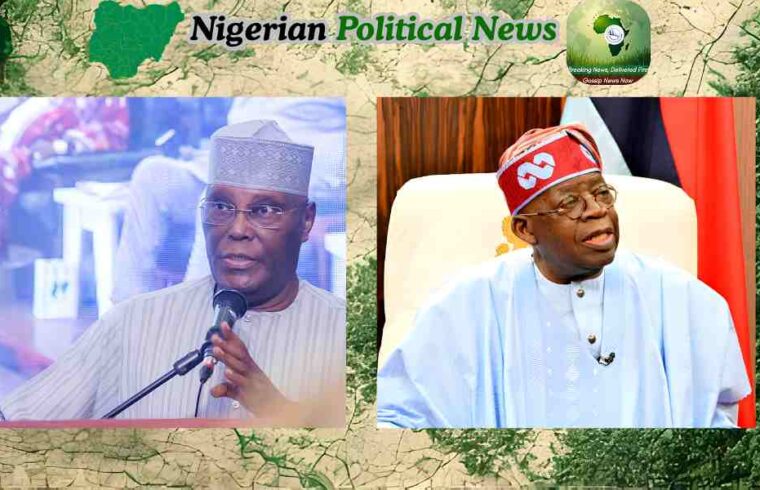
Former Vice President Atiku Abubakar has declared that President Bola Tinubu’s time in office is coming to an end, saying he expects to take over the presidency after the 2027 election.
Atiku, the African Democratic Congress (ADC) presidential candidate, also criticised the Tinubu administration’s economic policies, particularly the removal of the fuel subsidy and the government’s efforts to reduce transportation costs through Compressed Natural Gas (CNG).
In Brief
Atiku said Tinubu should begin preparing his handover notes ahead of the 2027 presidential election, while accusing the administration of subjecting Nigerians to economic hardship.
He argued that the government’s CNG conversion programme had not achieved enough to cushion the effects of subsidy removal and described the latest efforts to reduce transport fares as inadequate and belated.
Atiku also promoted his proposal for a production-based subsidy as an alternative approach to addressing the cost-of-living crisis.
What Happened?
The former Vice President made the remarks in a statement issued on Friday by his Senior Special Assistant on Public Communication, Phrank Shaibu.
Atiku accused the Tinubu administration of using Nigeria as an economic experiment since it assumed office in 2023.
He particularly criticised the removal of the fuel subsidy, arguing that the policy had contributed to increased transportation costs, higher food prices and greater pressure on households and businesses.
Atiku also reacted to the government’s latest pledge to work with state governors to reduce public transport fares.
He argued that the intervention had come too late after Nigerians had already endured years of rising transportation costs.
“President Tinubu, Nigerians have paid enough for your economic experiment. Too little. Too inadequate. Too late. Your time is up. Prepare your handover. We are coming to make life affordable again,” Atiku said.
Key Players
The political dispute centres on two presidential contenders ahead of the 2027 election.
Atiku Abubakar is the ADC presidential candidate and a former Vice President of Nigeria. In the statement, he positioned himself as an alternative to the Tinubu administration and criticised its economic record.
Bola Tinubu is the incumbent President whose economic policies, including the removal of the petrol subsidy and the government’s CNG initiative, came under attack in Atiku’s statement.
Phrank Shaibu, Atiku’s Senior Special Assistant on Public Communication, issued the statement on his principal’s behalf.
The Numbers Behind Atiku’s CNG Criticism
A major part of Atiku’s argument focused on the number of vehicles that have reportedly been converted to CNG.
According to Atiku, approximately 120,000 vehicles have been converted to CNG in more than three years.
He compared that figure with an estimate of roughly 14 million vehicles on Nigerian roads.
Atiku said the 120,000 conversions amount to less than one per cent of the estimated vehicle population.
He used the figure to argue that the government’s CNG programme had not delivered sufficient results to address the economic consequences of subsidy removal.
Atiku’s Strongest Criticism Of Tinubu
Atiku described the CNG conversion figure as evidence of what he called policy failure.
He argued that if CNG conversion was the government’s major strategy for cushioning the effects of petrol subsidy removal, the scale of conversion showed that the approach had fallen far short of what Nigerians needed.
He compared the reported conversion rate to a poor examination result, arguing that Nigerians should not be expected to reward what he described as inadequate performance with another four years in office.
“The truth is simple: Nigeria cannot afford another four years of monumental failure,” he said.
The assessment of the government’s performance and the characterisation of the CNG programme as a failure are Atiku’s political claims.
The Subsidy And Transport Fare Dispute
Atiku also challenged the government’s recent focus on reducing public transport fares.
He argued that the administration’s suggestion that cheaper fuel should lead to cheaper transportation amounted to an admission that the consequences of its policies had not been adequately addressed.
According to Atiku, the removal of the petrol subsidy without what he described as a credible cushioning framework contributed to increased transport costs, food prices and the cost of doing business.
He said Nigerians had continued to bear those pressures for more than three years while seeking relief from the government.
Atiku’s Alternative Proposal
Atiku said his proposed response would involve replacing the existing approach with a production-based subsidy aimed at addressing the cost-of-living crisis.
He argued that the proposal, which he said the government had previously criticised, had now become relevant to the administration’s response to rising transportation costs.
“Now that elections are approaching, and Nigerians are rallying behind Vice President Atiku Abubakar’s proposal for a production-based subsidy to immediately tackle the cost-of-living crisis created by Tinubu, the same government that ridiculed and criticised Atiku’s plan has suddenly discovered that Nigerians need cheaper transportation,” he said.
Atiku described the government’s intervention as “medicine after death,” arguing that measures to reduce transportation costs should have accompanied the removal of the subsidy much earlier.
What Atiku Says He Would Do Differently
Atiku also outlined elements of the economic approach he says an administration under his leadership would pursue.
He said he would support domestic refining, monitor crude oil production, control costs and reduce energy expenses.
He also said his proposed approach would be designed to ensure that relief reaches commuters, farmers, workers, traders and small business owners rather than politically connected intermediaries.
Atiku contrasted that approach with what he described as the Tinubu administration’s reliance on palliatives.
“Tinubu manufactures hardship and distributes palliatives. Atiku will attack hardship at its source,” he said.
The statement is Atiku’s description of the difference between his proposed policies and those of the current administration.
Where The Dispute Stands
The dispute now places transportation costs and subsidy policy within the broader political contest ahead of 2027.
The Tinubu administration has pursued CNG conversion and other measures aimed at reducing the cost of transportation, while Atiku is arguing that the response has come too late and has not gone far enough.
Atiku is also using the issue to promote his production-based subsidy proposal and to challenge the economic record of the incumbent administration.
His criticism comes alongside his wider claim that Nigerians should choose a change in leadership at the next presidential election.
Why Atiku’s Challenge Matters
Atiku’s statement combines an attack on the Tinubu administration’s economic record with an early effort to define what a change of government would mean under his leadership.
By telling Tinubu to prepare his handover, Atiku is presenting the 2027 election as a contest in which he expects presidential power to change hands.
His focus on CNG conversion and transport fares gives that political challenge an economic dimension, allowing him to connect the question of leadership change with the everyday pressures of transportation costs and the wider cost-of-living crisis.
However, Atiku’s prediction of victory remains a political assertion. The statement does not independently establish the outcome of the 2027 election.
Political Significance
The remarks show how economic policy is becoming part of the opposition’s broader case for a change of government ahead of 2027.
Atiku is using the effects of subsidy removal, transportation costs and the scale of CNG conversion to argue that the Tinubu administration has not adequately addressed the economic difficulties facing Nigerians.
At the same time, he is presenting his production-based subsidy proposal and wider economic plans as an alternative.
The result is a political argument that goes beyond whether CNG can reduce transport costs: Atiku is using the government’s economic record to make a case for why Nigerians should consider a different presidential leadership in 2027.