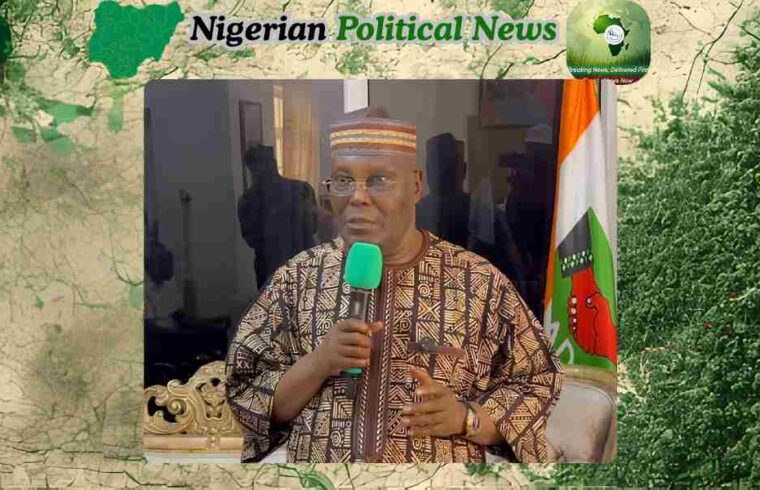
Former Vice President of Nigeria and 2027 presidential candidate of the African Democratic Congress (ADC), Atiku Abubakar, has questioned President Bola Tinubu’s decision to embark on a three-week leave while Vice President Kashim Shettima is also outside the country.
Atiku argued that the simultaneous absence of the two top political leaders has created a disturbing vacuum of political leadership and could potentially develop into a constitutional vacuum.
In Brief
- President Bola Tinubu embarked on a three-week leave.
- Vice President Kashim Shettima travelled to Luanda, Angola, on official duty.
- Atiku questioned the timing of Tinubu’s absence.
- He argued that Nigeria is facing economic and security challenges that require presidential attention.
- Atiku said the situation has created a political leadership vacuum and could potentially become a constitutional vacuum.
- He also accused the President of being disconnected from the hardship being experienced by Nigerians.
What Happened?
President Bola Tinubu embarked on a three-week leave while Vice President Kashim Shettima travelled to Luanda, Angola, to represent him at the 21st Extraordinary Session of the Assembly of Heads of State and Government of the African Union.
The development drew criticism from Atiku, who questioned the decision for the President to leave the country at a time when the Vice President was also abroad.
In a statement on Sunday, Atiku argued that the timing of Tinubu’s trip was difficult to understand given the challenges facing Nigerians.
He said the country may not currently be experiencing a constitutional vacuum, but maintained that there was a troubling vacuum of political leadership.
The Key Players
Tinubu is the President of Nigeria, while Shettima serves as Vice President.
Atiku, who previously served as Vice President, is also preparing for the 2027 presidential contest under the African Democratic Congress (ADC).
His criticism therefore comes from a major opposition political figure and former occupant of the country’s second-highest elected office.
Atiku’s Main Argument
Atiku said there is an important distinction between the decision of an ordinary citizen to travel and the responsibilities attached to the office of the President.
He acknowledged that he had travelled and spent time abroad himself but argued that the circumstances were different for a sitting President.
According to Atiku, Nigerians were dealing with rising food prices, increasing transport fares, insecurity and other hardships while the President had left the country for three weeks.
He said:
“There is a disturbing vacuum of political leadership.”
Atiku further argued that leadership requires more than occupying an office and exercising the constitutional powers attached to it.
He said leaders must also recognise situations when their presence is required at home.
Atiku’s Strongest Criticism
Atiku questioned the timing of Tinubu’s leave, particularly because Shettima was simultaneously outside Nigeria on official duty.
He argued that the circumstances made the President’s decision more difficult to understand and suggested that the leadership of the country should be more visibly engaged with the difficulties confronting citizens.
Atiku illustrated his argument with a comparison involving a family facing an emergency.
“A father may travel when all is well. But when his roof is burning and his family is trapped inside, he does not pick up his suitcase and head for the airport.”
He maintained that the issue was not whether a President should ever rest or travel, but whether the timing of such travel was appropriate given the country’s circumstances.
Why Atiku Says Tinubu Does Not Feel The People’s Pain
Atiku said Tinubu’s decision to embark on leave at this particular time suggested that the President was disconnected from the difficulties faced by ordinary Nigerians.
He pointed to the rising cost of living, expensive transportation, food prices and insecurity as examples of the hardship confronting citizens.
He said:
“That is the issue here. It is not that a President must never rest or travel. It is that Nigeria is burning, and the President has chosen a boarding pass over the fire extinguisher.”
Atiku further argued that millions of Nigerians were struggling to afford basic movement and necessities while the President was travelling.
He said a government that could not understand the pain experienced by citizens would struggle to summon the political will required to address those problems.
The Leadership Question
The central issue raised by Atiku is not simply whether Tinubu is entitled to take leave.
Rather, his argument concerns the implications of the President and Vice President being outside the country at the same time.
Atiku said the situation had created what he described as a political leadership vacuum, while warning that it could potentially develop into a constitutional vacuum.
However, the supplied report does not establish that Nigeria is currently experiencing a constitutional vacuum or that Tinubu’s leave constitutes a constitutional violation.
The constitutional concern is Atiku’s political argument about the circumstances surrounding the simultaneous absence of the President and Vice President.
Constitutional Perspective
Atiku’s reference to a possible constitutional vacuum gives the controversy an institutional dimension.
His argument raises a question about leadership continuity when the President is away from the country and the Vice President is also abroad.
However, the report does not provide an independent constitutional interpretation explaining whether the circumstances amount to a constitutional problem.
For that reason, Atiku’s warning should be understood as his assessment of the situation, rather than as an established legal conclusion.
The immediate facts presented are that Tinubu is on leave and Shettima travelled to Angola to represent him at an African Union meeting.
Political Implications
The controversy provides the opposition with an opportunity to question the administration’s priorities and the President’s availability during a period of economic and security difficulties.
For Atiku, the timing of Tinubu’s leave is particularly significant because he argues that Nigerians are experiencing serious hardship and require stronger political leadership.
His criticism also shifts the debate beyond the President’s personal decision to travel towards broader questions about leadership visibility, continuity and responsiveness.
Whether the criticism gains wider political traction will depend on how Nigerians and other political actors assess the circumstances surrounding the President’s absence.
Governance Perspective
Atiku’s argument also touches on the broader question of how political leadership should function during periods of national difficulty.
His position is that the responsibilities of high public office require leaders to exercise judgment about when their presence is most needed.
The issue, therefore, is not simply physical presence but the public perception of whether the country’s leadership is sufficiently engaged with the problems confronting citizens.
The supplied report does not include a response from the Presidency or another independent governance authority to Atiku’s criticism.
Political Significance
Atiku’s intervention has turned Tinubu’s three-week leave into a broader political debate about leadership, national hardship and institutional continuity.
His central argument is that the simultaneous absence of the President and Vice President raises questions about political leadership at a time when Nigerians are facing rising living costs, transport fares, food prices and insecurity.
Atiku concluded his statement by contrasting his assessment of the current administration with his own political promise:
“Tinubu made Nigeria expensive. I will make Nigeria affordable again.”
The statement therefore combines criticism of Tinubu’s decision to travel with Atiku’s wider argument that Nigeria needs leadership that is more responsive to the difficulties facing its citizens.