

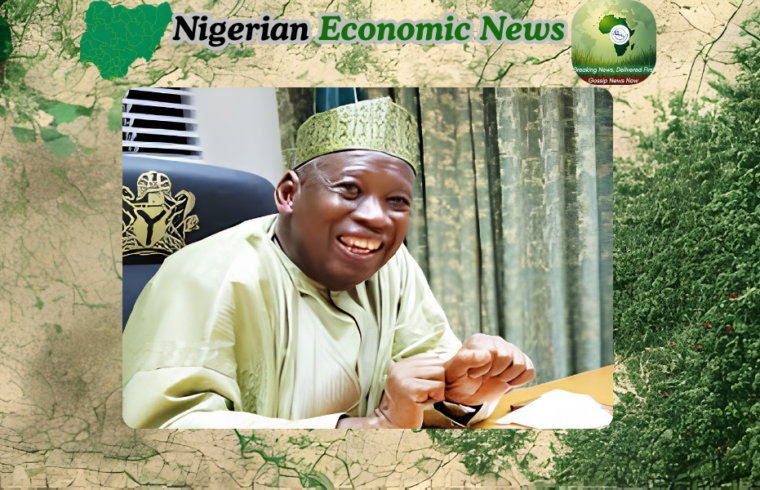
Fresh reactions have continued to trail the lingering Kano emirship controversy as respected Kano elder and cultural scholar, Ibrahim Ado Kurawa, openly questioned the stance of former Kano State Governor, Abdullahi Ganduje, regarding the recognition of Muhammadu Sanusi II as Emir of Kano.
The elder statesman accused the former governor of sending conflicting signals over the sensitive traditional leadership dispute currently attracting national attention. According to him, recent developments already showed that Ganduje had indirectly acknowledged Sanusi II despite later attempts to clarify his position publicly.
Gossip News Now reports that the controversy intensified after Ganduje reportedly addressed Sanusi with the Emir title during the swearing-in ceremony of Murtala Sule Garo as Deputy Governor at the Kano Government House. The comment later generated widespread debate across political and traditional circles in the state.
However, the former APC National Chairman later distanced himself from the recognition through a statement issued by his former Chief of Staff, Mohammad Garba, insisting that the title reference was merely ceremonial and should not be interpreted as a political endorsement in the emirship tussle.
Despite that explanation, Kurawa argued that actions taken by the former governor in the past suggested otherwise. He claimed that Ganduje had previously sought the authority of Sanusi II during arrangements involving the installation of his nephew as a village head.
The Kano elder further questioned why the former governor did not present his nephew before Aminu Ado Bayero if he genuinely believed Bayero was the rightful emir.
Beyond the public disagreement, Kurawa also attempted to clarify what he described as misconceptions surrounding the ongoing legal battle before the Supreme Court. According to him, the court matter is not directly about determining who occupies the Kano throne.
He explained that the legal dispute mainly revolves around issues connected to the rights of a titleholder affected during reforms carried out under the emirate law introduced during Ganduje’s administration.
The scholar also revisited the controversial 2019 restructuring of the Kano Emirate Council, a move that created additional emirates and triggered legal battles from several prominent indigenes of the state.
According to Kurawa, he was among those who challenged the legality of the emirate law alongside late politician Bashir Tofa and others, citing procedural irregularities in the legislative process that produced the law.
He noted that although a State High Court reportedly nullified aspects of the legislation because of those procedural flaws, the emirs appointed under the arrangement were not removed afterward.
The Kano elder added that the current administration under Governor Abba Yusuf later introduced another bill aimed at repealing the emirate laws, which was subsequently passed by the State Assembly without facing a direct legal challenge on procedural grounds.
In his analysis of the court proceedings, Kurawa maintained that the focus of the ongoing case concerns allegations relating to fundamental human rights and jurisdictional questions tied to the Federal High Court rather than deciding the authentic Emir of Kano.
He stressed that political actors should avoid presenting the matter as though the Supreme Court is currently selecting between Sanusi II and Aminu Ado Bayero for the throne.
Political And Traditional Implications
The renewed comments from Kurawa highlight how deeply divided opinions remain over the Kano emirship issue years after the restructuring of the traditional institution under the previous administration.
Observers believe the continued public debate reflects the influence the Kano emirate still holds within Northern Nigeria’s political and cultural landscape. Analysts also note that statements from key political figures are likely to keep shaping public perception as the legal process continues.
For many residents and stakeholders, the dispute now goes beyond traditional leadership alone and has become closely linked with political loyalty, governance decisions, and regional influence within Kano State.