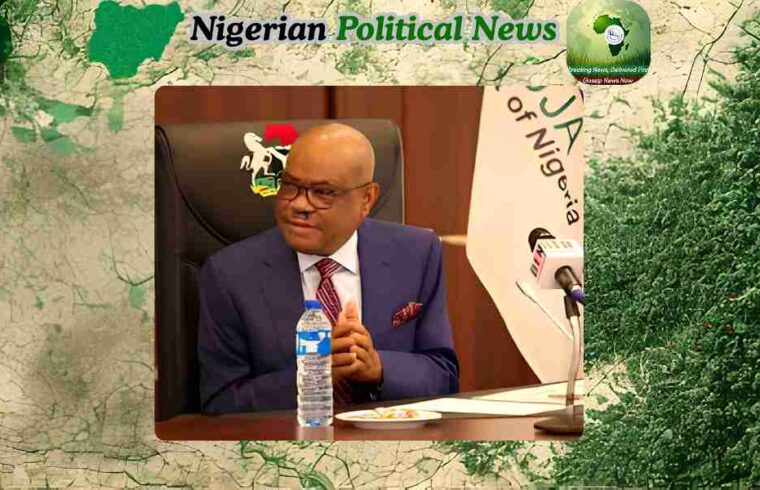
Wike’s 2027 Claim Draws Political Pushback
Minister of the Federal Capital Territory (FCT), Nyesom Wike, has asserted that he remains in control of the political structure in Rivers State and the FCT ahead of the 2027 general election, saying he owes President Bola Tinubu the delivery of both areas.
The claim has, however, drawn a challenge from the Nigeria Democratic Congress (NDC), which questioned Wike’s ability to determine electoral outcomes in Rivers State and the nation’s capital.
Wike made the declaration on Wednesday while speaking with journalists in Port Harcourt, where he was asked whether Rivers State Governor Siminalayi Fubara currently controls the state’s political structure.
Key Facts
- Wike says being governor is not a requirement for controlling a political structure.
- He describes himself as the “General Commander of the Political Infantry.”
- He says he is in charge of the political structure in Rivers State and the FCT.
- Wike says he owes President Bola Tinubu the delivery of both areas in the 2027 election.
- The NDC has challenged Wike’s claim that he can deliver Rivers State and the FCT for Tinubu.
- The NDC says voters will ultimately determine and protect the election results.
Wike Says Political Influence Goes Beyond the Governor’s Office
Responding to the question about Governor Siminalayi Fubara’s influence in Rivers State, Wike argued that occupying the office of governor was not the only way to remain politically influential.
The FCT minister said his influence should not be measured solely by whether he holds the governorship, insisting that he remains in charge of the political structure.
“You do not need to be governor before you can be in charge,” Wike said.
He went further by describing himself as the “General Commander of the Political Infantry” and maintained that he was in charge both in Rivers State and the FCT.
Wike also linked his political responsibility to President Bola Tinubu and the forthcoming election.
“I owe the president to give these two,” he said, referring to Rivers State and the FCT.
He added that the FCT should be regarded as a state when considering the 2027 election.
The Dispute Extends Beyond Rivers State
Wike’s remarks place both Rivers State and the FCT at the centre of his political calculations for the 2027 election.
His argument is that political control does not necessarily depend on occupying an elected office. By presenting himself as the person responsible for the political structures in the two areas, Wike is asserting a level of influence that extends beyond his current position as FCT minister.
The claim has also brought the question of political influence into the wider 2027 contest, particularly over whether an individual political figure can translate organisational influence into electoral support.
NDC Challenges Wike’s Claim
The Nigeria Democratic Congress has rejected Wike’s suggestion that he can deliver Rivers State and the FCT for Tinubu in 2027.
Through its Director of New Media and Strategic Communications, Theo Abu Agada, the NDC cautioned Wike over his claims and questioned whether he could simply determine the outcome of an election in the two areas.
Agada said Wike must be joking if he believes he can “just write election results” in Rivers State and the FCT.
The response followed Wike’s submission during his monthly media chat that he would not remain passive and allow African Democratic Congress (ADC) presidential candidate Atiku Abubakar to win the 2027 election.
The NDC chieftain argued that Wike was acting as though he alone would make electoral decisions in Rivers State and the FCT.
Agada maintained that voters would have a central role in determining the outcome, vowing that the people would vote, monitor and protect their votes during the 2027 election.
Political Implications
The disagreement highlights a broader question surrounding political influence ahead of the 2027 election: whether control of a political structure can necessarily translate into control of voters’ choices.
Wike’s position presents him as a significant political actor capable of influencing the direction of Rivers State and the FCT. The NDC’s response, however, directly challenges that interpretation and places emphasis on the role of voters and the protection of their ballots.
The dispute therefore moves beyond the personal exchange between Wike and his critics. It also reflects the competing claims that are likely to emerge as political actors position themselves for the 2027 election.
For now, Wike maintains that he is in charge of the political structures in Rivers State and the FCT and intends to deliver both areas for Tinubu, while the NDC insists that electoral outcomes cannot simply be predetermined by political declarations.
What’s Next?
The dispute is likely to remain part of the wider political conversation as preparations for the 2027 election continue.
Wike’s claim has established his position on his political influence in Rivers State and the FCT, while the NDC has publicly challenged that position and stressed the importance of voters and the protection of their votes.
The eventual political contest will determine how the competing claims translate into electoral support. For now, the disagreement adds another layer to the growing political positioning surrounding the 2027 election.